
Building a mobile application is an important investment for businesses looking to improve customer engagement, streamline operations, and expand their digital presence. However, choosing the right technology and development team can significantly influence the success of your application.
React Native has become a popular choice for mobile app development because it allows businesses to build applications for both Android and iOS using a shared JavaScript and React-based codebase. This approach can help reduce development time, simplify maintenance, and create consistent user experiences across platforms.
But hiring the right React Native development team requires more than finding developers who know the framework. You need professionals who understand your business goals, application requirements, user experience, security, and long-term scalability.
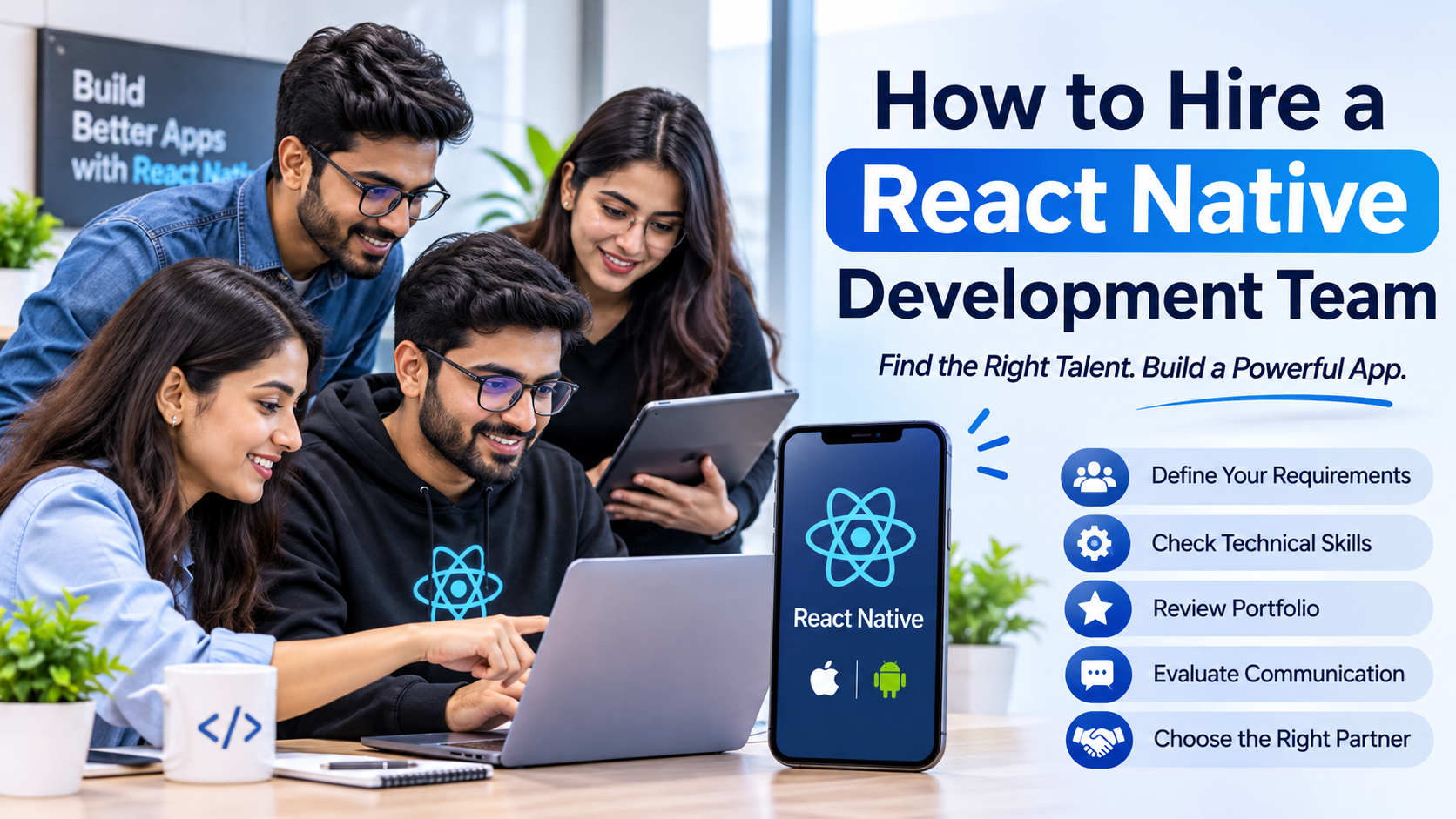
In this guide, we will explore how to hire a React Native development team, what skills to look for, which hiring models to consider, and how to select the right development partner for your project.
Before searching for a development team, clearly outline what you want to build. A well-defined project scope helps developers understand your expectations and provide more accurate timelines and cost estimates.
Start by identifying:
You should also determine whether you need a Minimum Viable Product (MVP) or a fully featured mobile application.
A clear project scope helps potential development teams understand the complexity of your requirements before development begins.
Not every mobile app developer has the experience required to deliver a reliable React Native application.
Look for a team with practical experience in building and maintaining cross-platform mobile applications.
Some important technical skills include:
A strong development team should also understand performance optimization, application security, and platform-specific requirements.
Ask whether the team has experience handling complex integrations, offline functionality, and applications with large user bases.
A portfolio provides practical evidence of a development team’s capabilities.
Before hiring, review applications they have previously developed. If possible, download those applications and explore their functionality.
Pay attention to:
Ask the development company to explain its role in each project. Find out whether it handled the complete development process or contributed to only a specific part.
You should also ask for examples of projects similar to yours in terms of functionality, industry, or technical complexity.
Previous work can help you understand whether the team has the experience to manage your project successfully.
A mobile application should not only function properly but also provide an intuitive experience.
Even a technically advanced application can struggle to attract users if its navigation is confusing or its interface is difficult to understand.
Your React Native development team should understand how to translate UI/UX designs into functional mobile interfaces.
Evaluate whether they can help with:
Ask whether UI/UX designers work alongside developers throughout the project.
This collaboration helps ensure that the final application matches the approved design and provides a consistent experience across devices.
A professional development team should follow a structured development process rather than jumping directly into coding.
A typical React Native development workflow includes:
Requirement Analysis: Understanding business objectives, technical requirements, and application functionality.
Planning and Architecture: Selecting the right architecture, libraries, integrations, and development approach.
UI/UX Design: Creating wireframes, prototypes, and interface designs.
Development: Building application features, integrating APIs, and implementing business logic.
Quality Assurance: Testing application functionality, compatibility, performance, and security.
Deployment: Preparing and publishing the application on Google Play and the Apple App Store.
Maintenance: Monitoring performance, fixing bugs, and releasing updates.
Ask potential development partners how they manage project timelines, code reviews, testing, and communication.
Regular progress updates and milestone-based delivery can help you maintain visibility throughout the development process.
Technical expertise alone does not guarantee a successful mobile app project.
Communication plays an equally important role, especially when working with a remote or offshore development team.
Before hiring, understand how the team manages communication and project progress.
Consider asking:
Common project management tools include Jira, Trello, Asana, and Slack.
Choose a team that provides transparent communication, clear responsibilities, and a structured feedback process.
Businesses can hire React Native developers through different engagement models depending on their project requirements, budget, and internal resources.
A dedicated team works exclusively on your project during the agreed engagement period.
This model is suitable for businesses developing complex applications, managing long-term projects, or planning continuous product improvements.
Best for: Large applications, ongoing development, and long-term projects.
Under this model, the project scope, deliverables, timeline, and total cost are agreed upon before development begins.
It works well when requirements are clearly defined and major changes are unlikely.
Best for: MVPs, small applications, and projects with a clearly defined scope.
In this model, businesses pay for the actual development hours or resources used.
It provides flexibility when requirements may evolve during development.
Best for: Projects with changing requirements and continuous development needs.
Before selecting a model, compare the level of flexibility, resource availability, project control, and overall cost.
Development costs vary depending on application complexity, feature requirements, integrations, team experience, and project duration.
A basic application with limited functionality will generally require fewer resources than a complex application with real-time communication, payment processing, and advanced backend integrations.
Request a detailed proposal that includes:
Avoid selecting a development team based only on the lowest quotation.
An unusually low estimate may exclude important activities such as testing, documentation, security reviews, or maintenance.
Focus on the overall value, technical capabilities, and quality of delivery.
Your mobile application is a valuable business asset. Before signing an agreement, make sure ownership and security responsibilities are clearly documented.
Important points to discuss include:
Source Code Ownership: Confirm that you will receive the complete source code and agreed intellectual property rights.
Code Documentation: Ensure the team provides technical documentation and setup instructions.
Data Security: Discuss secure authentication, API protection, encryption, and data privacy requirements.
Version Control: Check whether the team uses Git-based version control and maintains proper development branches.
Third-Party Licenses: Understand the licensing requirements of libraries and external services used in the application.
Maintenance Support: Clarify how bugs, updates, compatibility issues, and future improvements will be handled.
A reliable development partner should be transparent about these responsibilities from the beginning.
Before finalizing a React Native development team, arrange a technical and business discussion.
Here are some important questions to ask:
The answers will help you evaluate the team’s technical knowledge, communication practices, and ability to manage your project.
Businesses sometimes make hiring decisions based on cost or availability without properly evaluating technical capabilities.
Avoid these common mistakes:
Taking time to evaluate these areas can help reduce development risks and prevent unexpected expenses.
Hiring the right React Native development team is an important step toward building a successful mobile application. Businesses should evaluate technical expertise, previous project experience, development processes, communication practices, pricing, and long-term support before making a decision.
A capable development partner will do more than write code. They will understand your business objectives, recommend suitable technical solutions, and help transform your application idea into a reliable digital product.
Whether you are planning an MVP, launching a customer-facing mobile application, or modernizing an existing business platform, choosing an experienced development team can make the entire process more efficient.
Looking for a reliable React Native development team?
TechieDom helps businesses turn their ideas into functional digital solutions through modern development technologies and tailored software development services. Get in touch with the team to discuss your mobile application requirements and explore the right development approach for your business.
The cost depends on application complexity, required features, team size, experience, and project duration. A detailed project assessment is recommended to determine the estimated budget.
A basic application may take a few weeks to a few months, while complex applications can require several months or longer depending on integrations, functionality, and testing requirements.
Yes. React Native can be used to build business applications such as eCommerce platforms, booking systems, customer portals, fintech interfaces, and on-demand service applications.
A freelancer may be suitable for small projects or specific development tasks. A dedicated team is generally a better option for complex applications requiring multiple skills, ongoing development, and structured project management.
A team should have expertise in React Native, JavaScript or TypeScript, API integration, state management, UI/UX implementation, testing, debugging, performance optimization, and mobile app deployment.
Yes. React Native supports cross-platform development, allowing teams to build applications for Android and iOS using a shared codebase while implementing native functionality where required.