
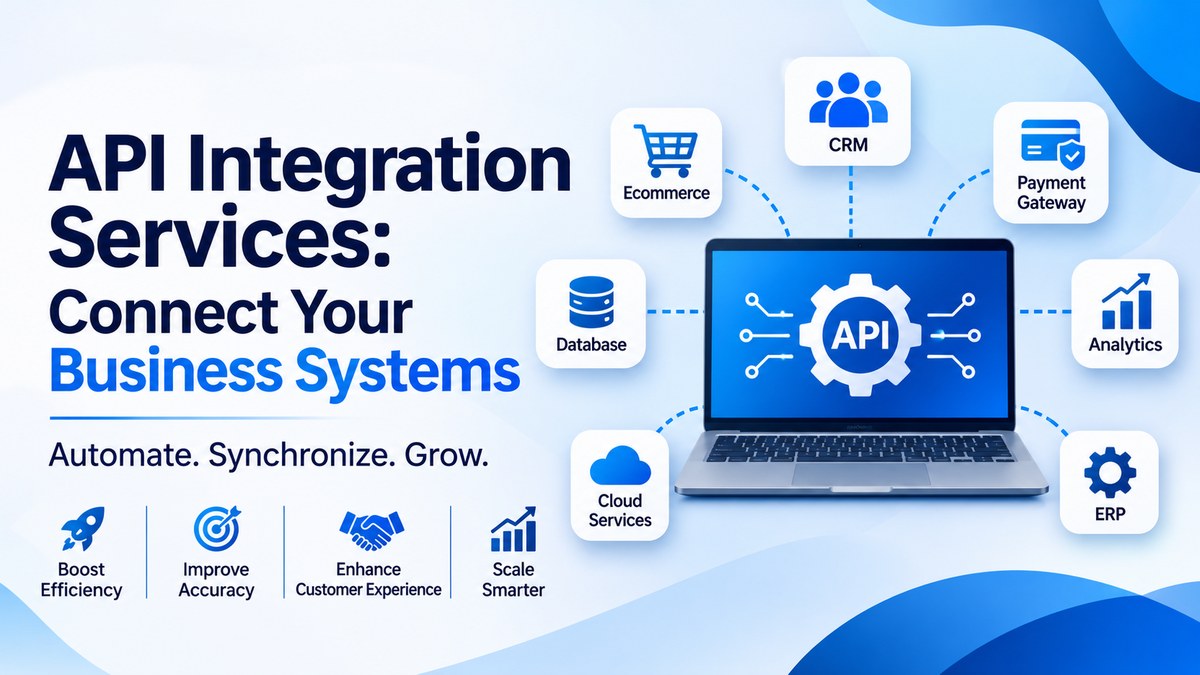
Modern businesses rely on multiple software applications to manage daily operations. From customer relationship management (CRM) and accounting platforms to inventory management, payment gateways, and marketing tools, each system plays an important role. However, when these applications operate independently, businesses often face data duplication, manual work, communication gaps, and operational inefficiencies.
This is where API integration services become valuable. By connecting different software applications through Application Programming Interfaces (APIs), businesses can automate workflows, exchange information, and create a more connected digital environment.
Whether you operate a startup, an ecommerce business, or an established enterprise, integrating your business systems can improve productivity and support long-term growth.
API integration services involve connecting two or more software applications so they can communicate and exchange data automatically.
An API acts as a bridge between applications, allowing them to share information and perform specific actions without requiring manual intervention.
For example, when a customer places an order on an ecommerce website, an API integration can automatically:
Instead of managing these activities separately, API integration allows different systems to work together through a unified workflow.
As businesses grow, they often adopt new tools to manage different departments. Without proper integration, these systems can become disconnected, creating unnecessary complexity.
Here are some important reasons businesses invest in API integration services.
Manually transferring information between applications takes time and increases the possibility of human errors.
API integration automates data exchange between connected platforms. For example, customer details collected through a website can automatically appear in the CRM without requiring employees to enter the same information again.
This saves time and allows teams to focus on more important tasks.
Disconnected applications often create delays in business processes. Employees may need to switch between multiple platforms to complete a single task.
With API integration, different systems can communicate automatically. This creates smoother workflows, reduces repetitive activities, and improves overall operational efficiency.
When multiple systems store the same information independently, data inconsistencies can become a serious problem.
API integrations help synchronize information between connected applications. When configured correctly, updates made in one system can be reflected in other connected platforms.
This helps businesses maintain more reliable and consistent records.
Customers expect fast responses, accurate information, and smooth transactions.
Integrating CRM platforms, payment systems, customer support tools, and ecommerce applications helps businesses deliver a more connected customer experience.
For example, customer support representatives can access relevant order information directly through their support platform instead of switching between multiple applications.
As operations expand, businesses may introduce additional software applications, departments, and services.
A well-planned API integration architecture makes it easier to connect new tools without rebuilding the entire business infrastructure.
This gives businesses greater flexibility as their operational requirements change.
Different businesses require different integration solutions depending on their software infrastructure and operational goals.
Some of the most common types include:
CRM integration connects customer relationship management platforms with websites, marketing applications, sales tools, and customer support systems.
It allows businesses to synchronize customer information, track leads, automate follow-ups, and maintain a centralized view of customer interactions.
Payment gateway integration connects websites and applications with payment processing services.
It enables businesses to accept online payments, verify transactions, manage payment statuses, and process refunds through supported payment providers.
Enterprise Resource Planning (ERP) integration connects different business functions, including finance, inventory, procurement, and operations.
It helps organizations share information across departments and maintain better control over business processes.
Ecommerce API integration connects online stores with inventory systems, shipping providers, payment gateways, CRM platforms, and accounting software.
For example, an ecommerce business can automatically update inventory levels whenever a customer purchases a product.
Businesses frequently use external applications for email marketing, analytics, communication, scheduling, and customer management.
Third-party API integration allows these tools to exchange information and work together as part of a connected business ecosystem.
Successful API integration requires proper planning, development, testing, and ongoing maintenance.
Here is how a typical API integration project works.
The first step is understanding which applications need to communicate and what business problems the integration should solve.
Developers evaluate existing systems, data requirements, workflows, and expected outcomes before selecting an integration approach.
Every API has its own technical documentation, authentication requirements, endpoints, data formats, and usage limitations.
Developers review this documentation to understand how applications can exchange information and which integration methods are supported.
Depending on project requirements, developers may choose REST APIs, GraphQL APIs, webhooks, or middleware-based integration.
The right approach depends on application architecture, data complexity, performance requirements, and security considerations.
During development, APIs are configured to exchange information between connected applications.
This may involve building custom endpoints, implementing authentication, mapping data fields, handling API requests, and creating automated workflows.
Testing ensures that connected systems exchange information correctly.
Developers check successful responses, invalid requests, authentication failures, duplicate transactions, data synchronization, and error-handling scenarios.
After successful testing, the integration is deployed to the production environment.
Ongoing monitoring helps identify API failures, performance issues, authentication problems, and changes introduced by third-party platforms.
Building an API integration is not just about making two applications communicate. It is also important to ensure that the integration remains secure, reliable, and maintainable.
Consider the following best practices:
Following these practices helps businesses build dependable integrations that can support changing operational needs.
Although API integration offers several advantages, businesses may encounter technical challenges during implementation.
Some common challenges include:
Compatibility Issues: Different applications may use different data structures, programming languages, and communication protocols. Developers must ensure that information is mapped and exchanged correctly.
Security Risks: Poorly configured authentication, exposed API credentials, and insufficient access controls can create security vulnerabilities.
API Version Changes: Third-party providers may update or discontinue API versions. Integrations must be maintained to remain compatible with these changes.
Data Synchronization Problems: Network interruptions, duplicate requests, and inconsistent data formats can affect synchronization between applications.
Performance Limitations: High API request volumes or slow external services can affect application performance.
Working with experienced API developers helps businesses address these challenges through proper architecture, testing, and ongoing technical support.
Businesses can connect applications using ready-made integration platforms or custom API development.
Both approaches have advantages depending on the complexity of business requirements.
| Factor | Ready-Made Integration Tools | Custom API Integration |
|---|---|---|
| Implementation | Usually faster | Requires development |
| Customization | Limited by platform features | Highly flexible |
| Complexity | Suitable for standard workflows | Suitable for complex workflows |
| Maintenance | Often managed through the platform | Requires ongoing technical support |
| Scalability | Depends on platform capabilities | Can be designed around business needs |
Ready-made integration tools are useful for connecting popular applications through standard workflows.
However, businesses with unique processes, specialized software, or complex data requirements may benefit more from custom API integration.
You may need professional API integration services if:
A professional development team can evaluate your existing systems and recommend an integration strategy based on your technical and business requirements.
API integration plays an important role in building connected, efficient, and scalable business operations. By allowing different software applications to communicate and exchange information, businesses can reduce manual work, improve data accuracy, streamline workflows, and deliver better customer experiences.
However, successful integration requires the right technical approach, secure development practices, and ongoing maintenance.
At TechieDom, we help businesses develop software solutions that connect applications, automate workflows, and support their operational goals. Whether you need third-party API integration, custom API development, or connections between existing business systems, our development team can help you build a solution that fits your requirements.
Looking to connect your business applications? Contact TechieDom to explore the right API integration solution for your business.