

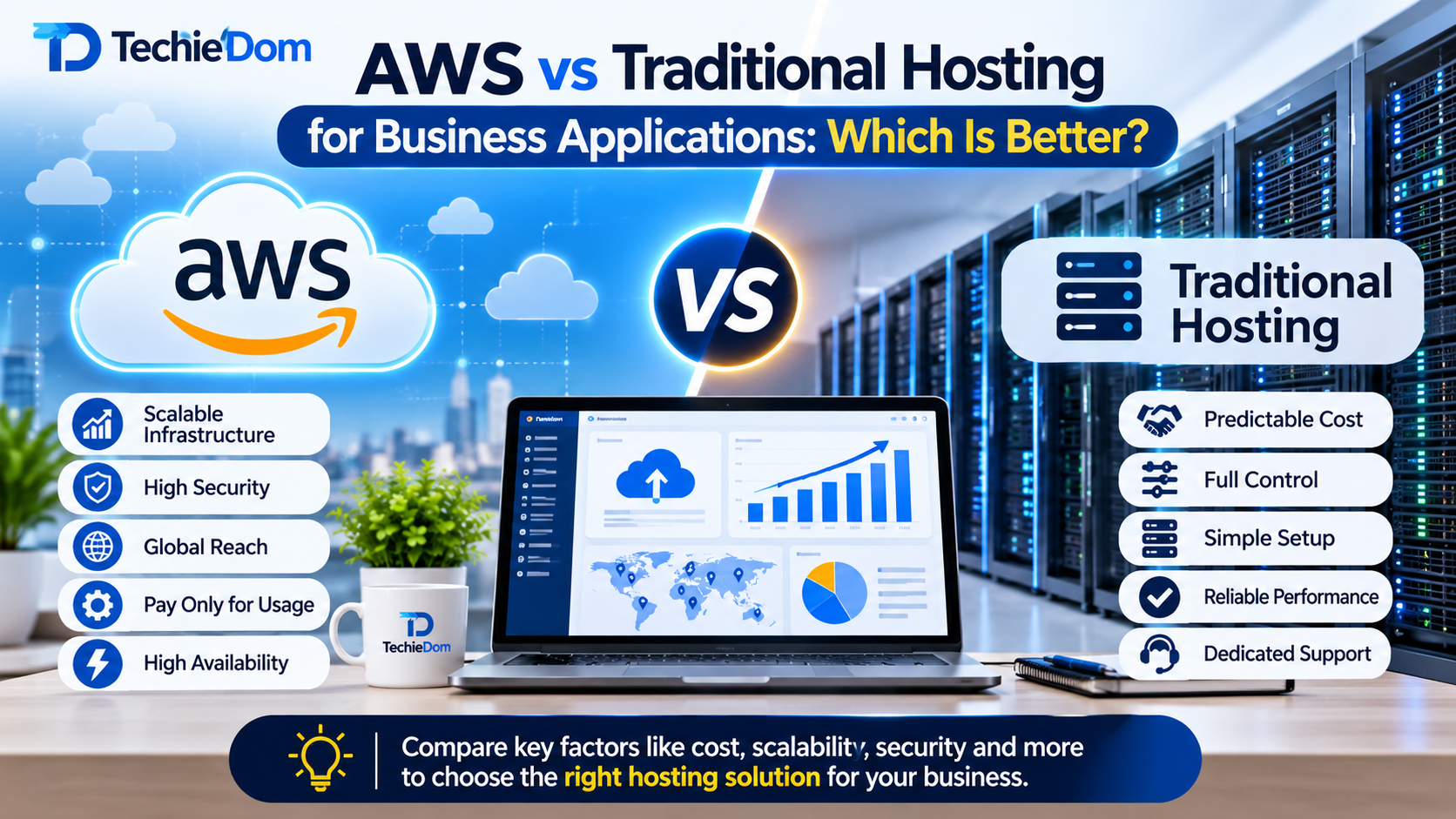
Choosing the right hosting environment is an important decision for businesses developing and managing digital applications. Hosting directly affects application performance, security, scalability, availability, and long-term infrastructure costs.
Traditionally, businesses have relied on shared hosting, VPS (Virtual Private Server), and dedicated servers to host their websites and business applications. However, cloud computing platforms such as Amazon Web Services (AWS) have introduced more flexible infrastructure options that allow businesses to scale resources based on changing requirements.
So, which option is better for your business: AWS or traditional hosting?
The answer depends on your application requirements, expected traffic, infrastructure budget, technical resources, and future growth plans.
In this guide, we will compare AWS and traditional hosting across important factors to help businesses make an informed decision.
Amazon Web Services (AWS) is a cloud computing platform that provides infrastructure and technology services over the internet.
Instead of depending on a single physical server, businesses can use AWS services to build, deploy, manage, and scale applications using cloud infrastructure.
AWS offers several services for hosting business applications, including:
Businesses can combine these services to create hosting environments that support different application requirements, from small business platforms to complex enterprise systems.
Traditional hosting refers to hosting environments where applications run on physical or virtual servers managed by a hosting provider or an internal IT team.
These solutions typically include shared hosting, VPS hosting, and dedicated server hosting.
Common traditional hosting options include:
Shared Hosting: Multiple websites share resources on the same physical server. It is generally suitable for smaller websites with limited traffic and infrastructure requirements.
VPS Hosting: A physical server is divided into multiple virtual environments, providing businesses with more control and dedicated resource allocations.
Dedicated Hosting: A business rents an entire physical server, allowing greater control over server configuration, hardware resources, and security settings.
Traditional hosting can be a practical option for businesses that need predictable infrastructure, straightforward hosting arrangements, or greater control over a specific server environment.
Before selecting a hosting solution, businesses should understand how both options compare across important infrastructure factors.
| Comparison Factor | AWS Hosting | Traditional Hosting |
|---|---|---|
| Infrastructure | Cloud-based infrastructure | Physical or virtual servers |
| Scalability | Flexible resource scaling | Often requires manual upgrades |
| Pricing | Usage-based pricing across services | Fixed or recurring hosting plans |
| Performance | Configurable infrastructure and global delivery options | Depends on server hardware and configuration |
| Maintenance | Managed services reduce infrastructure management | Provider or internal team handles server maintenance |
| Availability | Multiple availability and redundancy options | Depends on hosting provider and server setup |
| Security | Extensive cloud security tools and controls | Depends on provider and server configuration |
| Customization | Extensive infrastructure configuration | Varies by hosting plan and server access |
| Global Deployment | Multiple geographic regions | Depends on provider locations |
| Management | Requires cloud configuration and monitoring | Can be simpler for basic hosting environments |
Neither option is automatically better for every business. The right choice depends on the application’s technical and operational requirements.
Scalability is one of the biggest differences between AWS and traditional hosting.
As a business grows, its application may experience increased traffic, more user accounts, larger databases, and additional processing requirements.
AWS Hosting
AWS provides flexible infrastructure that allows businesses to increase or decrease resources based on application demand.
For example, an ecommerce platform may experience significant traffic increases during seasonal sales. AWS services such as EC2 Auto Scaling can automatically adjust computing capacity based on configured conditions.
Businesses can also use managed databases, load balancing, and cloud storage to support growing application requirements.
Traditional Hosting
Traditional hosting usually provides predefined server resources. If an application outgrows its current hosting plan, businesses may need to upgrade the server, increase allocated resources, or migrate to a more powerful environment.
VPS and dedicated hosting offer different levels of flexibility, but scaling may involve additional configuration or hardware changes.
Which Is Better?
AWS is generally more flexible for applications with unpredictable traffic or changing infrastructure requirements. Traditional hosting can still work well for applications with relatively stable resource demands.
Infrastructure costs play an important role in hosting decisions, especially for startups and small businesses.
However, businesses should compare the total cost of ownership rather than looking only at the monthly hosting price.
AWS Hosting Costs
AWS follows different pricing models depending on the services used.
Businesses may pay for:
AWS also offers pricing options such as On-Demand Instances, Savings Plans, and Reserved Instances for eligible services.
One advantage is that businesses can start with smaller infrastructure and expand as their requirements increase.
However, poor resource management, unnecessary services, and high data transfer usage can increase monthly expenses.
Traditional Hosting Costs
Traditional hosting providers generally offer fixed monthly or annual packages.
Pricing may depend on:
These plans can make infrastructure budgeting easier because businesses often know their recurring hosting expenses in advance.
Which Is Better?
Traditional hosting may offer more predictable pricing for smaller applications with stable requirements. AWS can provide greater flexibility for businesses that need adjustable infrastructure, but costs should be monitored carefully.
Application performance affects user experience, customer engagement, and business operations.
Slow-loading applications can frustrate users, increase abandonment rates, and affect conversions.
AWS Hosting
AWS provides several services that can help businesses improve application performance.
For example:
Businesses can also deploy applications across multiple Availability Zones to improve infrastructure resilience.
Traditional Hosting
Traditional hosting performance depends on server specifications, network connectivity, storage technology, resource allocation, and configuration.
A well-configured dedicated server can deliver excellent performance for applications with predictable workloads.
However, a single-server setup may become a bottleneck when traffic or processing requirements increase.
Which Is Better?
AWS offers more built-in options for distributing workloads and designing resilient infrastructure. Traditional dedicated hosting can also deliver strong performance when properly configured and maintained.
Security is essential for businesses handling customer information, payment details, employee records, and confidential company data.
Both AWS and traditional hosting can provide secure environments, but their security models differ.
AWS Hosting
AWS provides various security features and services, including:
AWS follows a shared responsibility model. AWS is responsible for security of the cloud infrastructure, while customers remain responsible for security in the cloud, including application configuration, access permissions, and data protection.
Traditional Hosting
Traditional hosting security depends on the hosting provider’s infrastructure and the security measures implemented by the business.
Common security practices include:
Businesses using unmanaged servers may need additional technical resources to maintain security.
Which Is Better?
AWS offers a broad range of security tools and centralized controls. However, neither AWS nor traditional hosting guarantees application security without proper configuration, monitoring, and maintenance.
Hosting infrastructure requires ongoing maintenance to ensure applications remain available, secure, and functional.
AWS Hosting
AWS provides managed services that reduce some infrastructure management responsibilities.
For example, Amazon RDS handles several database administration tasks, including automated backups and certain maintenance activities.
However, businesses still need to manage application deployments, cloud architecture, access permissions, resource monitoring, and infrastructure configurations.
AWS can also require specialized cloud engineering knowledge.
Traditional Hosting
Traditional hosting maintenance responsibilities depend on the selected hosting plan.
With managed hosting, the provider may handle operating system updates, server monitoring, backups, and security patches.
With unmanaged VPS or dedicated hosting, businesses may need to handle most server administration tasks themselves.
Which Is Better?
AWS managed services can reduce operational workload for specific infrastructure components. Managed traditional hosting may be easier for businesses that prefer a simpler server management arrangement.
Unexpected server failures, cyberattacks, accidental data deletion, and infrastructure disruptions can affect business operations.
A reliable hosting environment should include backup and disaster recovery planning.
AWS Hosting
AWS provides services that support backup and recovery strategies.
Examples include:
Businesses can design recovery strategies based on their recovery time objectives (RTO) and recovery point objectives (RPO).
Traditional Hosting
Traditional hosting providers may offer automated backups, manual backup configurations, and disaster recovery services.
However, businesses should confirm whether backups are stored separately from the primary server and whether recovery procedures are regularly tested.
Which Is Better?
AWS offers flexible tools for building distributed backup and recovery strategies. Traditional hosting can also support effective disaster recovery when appropriate backup systems and redundancy are configured.
Different business applications have different infrastructure requirements.
A SaaS platform may require multiple application services, while an internal business management system may need a simpler hosting environment.
AWS Hosting
AWS offers extensive customization options across computing, networking, storage, databases, and application deployment.
Developers can select different services based on their application’s architecture and technical requirements.
Traditional Hosting
Traditional hosting also provides customization, particularly through VPS and dedicated servers.
Businesses may configure server software, operating systems, databases, and application environments depending on the provider’s restrictions.
However, some shared hosting plans offer limited access to server-level configurations.
Which Is Better?
AWS is suitable for businesses that need flexible cloud architecture and access to a wide range of infrastructure services. VPS and dedicated hosting can be suitable when businesses need control over a specific server environment.
AWS can be a suitable choice for businesses with changing infrastructure requirements or applications that need advanced cloud capabilities.
Consider AWS if your business:
For example, an online marketplace experiencing seasonal traffic increases may benefit from AWS services that support automatic scaling and load balancing.
Traditional hosting can still be an effective solution for businesses with straightforward hosting requirements.
Consider traditional hosting if your business:
For example, a small business website with stable traffic and basic database requirements may operate efficiently on a managed VPS or dedicated hosting environment.
Businesses sometimes select hosting infrastructure without evaluating their actual application requirements.
Avoid these common mistakes:
1. Choosing Based Only on Price
The cheapest hosting plan may not provide the performance, reliability, or support your application needs.
2. Ignoring Future Scalability
Infrastructure should support expected business growth without requiring unnecessary redevelopment or complicated migrations.
3. Overlooking Security Responsibilities
Using a cloud platform does not automatically make an application secure. Proper access controls, encryption, monitoring, and updates are still necessary.
4. Not Monitoring Infrastructure Costs
Cloud resources that remain unused or are incorrectly configured can increase infrastructure expenses.
5. Ignoring Backup and Recovery Planning
Businesses should establish backup schedules and test recovery procedures before an unexpected incident occurs.
6. Selecting Technology Without Technical Evaluation
The hosting environment should match the application’s architecture, database requirements, traffic patterns, and operational needs.
Choosing between AWS and traditional hosting depends on your business application requirements, infrastructure budget, scalability expectations, and technical capabilities.
AWS provides flexible cloud infrastructure, advanced automation, managed services, and options for building distributed applications. Traditional hosting remains a practical choice for businesses that prefer straightforward infrastructure, predictable hosting plans, and stable resource requirements.
There is no universal solution for every business. The best hosting environment is the one that delivers the right balance of performance, security, reliability, cost, and long-term flexibility.
At TechieDom, we help businesses build and maintain digital solutions with infrastructure requirements in mind. From custom software development and web applications to API development and cloud-ready architecture, our focus is on creating technology solutions that support business growth.
Whether you are developing a new application or planning to modernize an existing system, selecting the right hosting strategy is an important step toward building a reliable digital platform.
AWS can be better for applications requiring flexible scalability, cloud integrations, and distributed infrastructure. Traditional hosting may be more suitable for applications with stable resource requirements and straightforward hosting needs.
Not necessarily. AWS costs depend on resource consumption, selected services, data transfer, and infrastructure configuration. Traditional hosting often uses fixed pricing plans, making monthly expenses more predictable.
Yes. Small businesses can use AWS services to host websites, applications, databases, and other digital solutions. However, they should choose services carefully and monitor usage to manage costs.
Both provide virtual computing environments. EC2 offers configurable cloud instances with additional AWS infrastructure integrations, while traditional VPS hosting generally provides a virtual server with predefined resources through a hosting provider.
AWS provides extensive security tools and infrastructure controls. However, security also depends on correct configuration, application development practices, access management, and ongoing monitoring.
Yes. Existing applications can be migrated to AWS after evaluating application architecture, database dependencies, storage, security, and performance requirements. A migration plan should include testing, backups, and a rollback strategy.
Managing AWS infrastructure effectively generally requires knowledge of cloud computing, networking, security, monitoring, and deployment. Businesses can also work with experienced cloud engineers or managed service providers.