
Launching a startup in the United States often requires building a reliable digital product while managing limited budgets, tight deadlines, and changing business requirements. Whether it is a SaaS platform, mobile application, custom business software, or an ecommerce website, startups need the right development expertise to turn their ideas into working products.
However, hiring a full in-house development team can be expensive, especially during the early stages of a business. This is why many US startups consider working with an offshore development team.
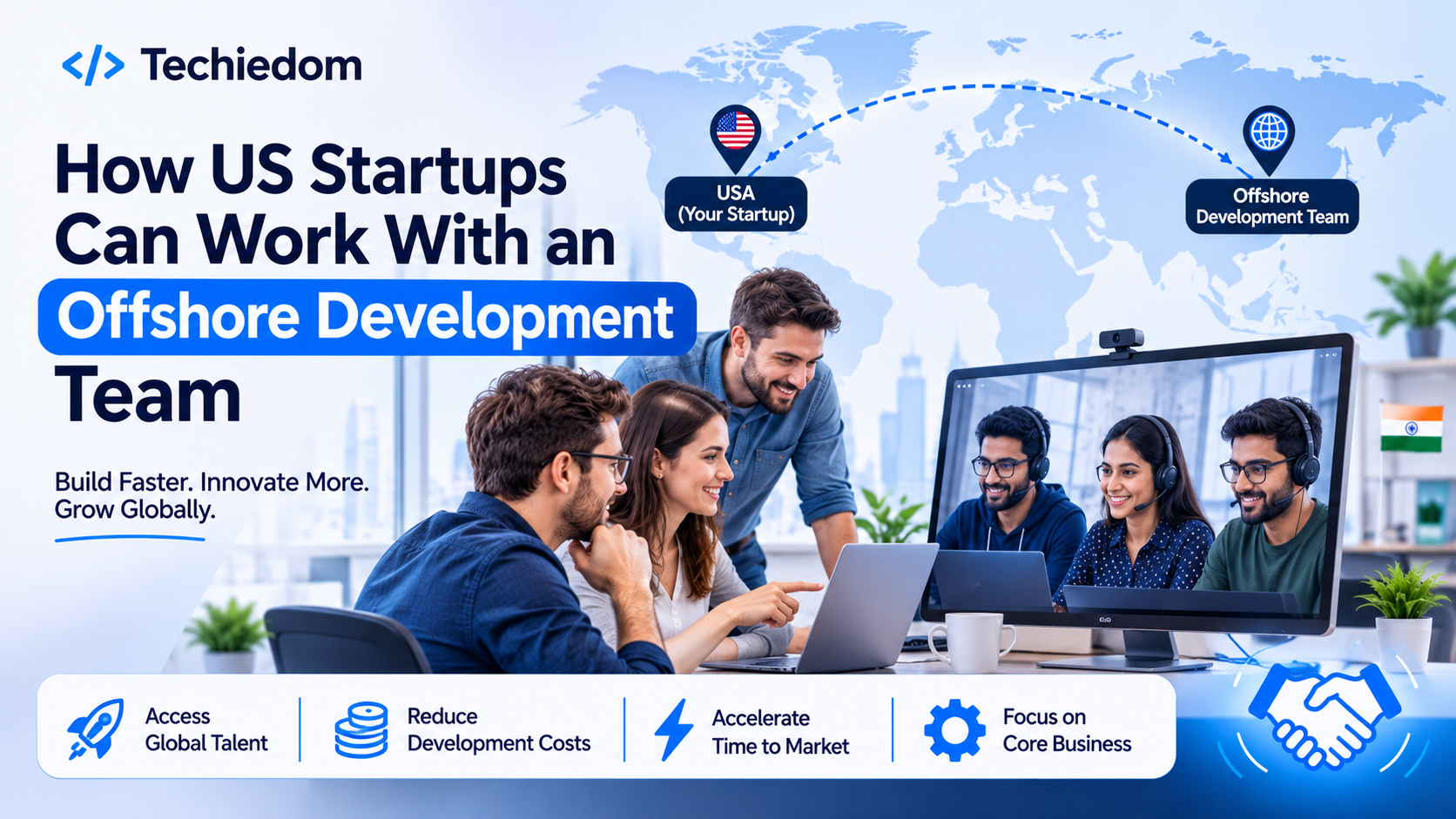
An offshore development team allows startups to access skilled developers, designers, testers, and project managers from another country without maintaining a full-time local workforce. When managed properly, this approach can help startups control costs, speed up development, and scale their technical capabilities.
In this guide, we will explain how US startups can work successfully with an offshore development team, what to consider before hiring, and how to avoid common challenges.
An offshore development team is a group of technology professionals located in another country who work on software development projects for a business.
For example, a startup based in the United States may partner with a software development company in India to build and maintain its web application.
Depending on the project, an offshore team may include:
The offshore team can work as an extension of the startup’s internal team or manage specific development tasks independently.
Startups need to make strategic decisions about where to invest their resources. Offshore development can provide access to technical expertise without the costs associated with building a large in-house team.
Here are some important reasons why startups consider this model.
Hiring developers in the US can involve significant expenses, including salaries, recruitment fees, employee benefits, office infrastructure, and training.
An offshore development partnership may reduce overall development costs while providing access to experienced professionals.
Startups can use the saved resources for other business priorities, such as marketing, customer acquisition, product research, and business expansion.
However, the lowest-priced provider is not always the best choice. Startups should evaluate technical quality, communication, project management, and long-term support alongside pricing.
Finding developers with the right technical skills can be challenging, particularly for startups working with specialized technologies.
Offshore development expands the available talent pool beyond the local hiring market.
Startups can find professionals experienced in:
This makes it easier to assemble a team around specific product requirements.
Startups often operate with tight launch schedules. Delays in development can affect fundraising, customer acquisition, and market opportunities.
An established offshore development team may already have the technical resources and workflows needed to begin a project.
With clear requirements and an organized development process, startups can work toward faster product releases and reduce the time spent on recruitment and onboarding.
A startup’s technical requirements can change as its product grows.
During the initial stage, it may need only a few developers to build a minimum viable product (MVP). Later, it may require additional frontend developers, backend specialists, testers, or cloud engineers.
An offshore development model can make it easier to adjust team size according to project requirements.
Startup founders often handle multiple responsibilities, including fundraising, sales, marketing, customer support, and business development.
Managing every technical activity internally can take time away from these priorities.
By partnering with a reliable offshore team, founders can delegate development tasks while retaining control over product direction and important business decisions.
Working with an offshore team requires more than selecting a development company and sharing project details. Startups need a structured approach to ensure that the partnership delivers the expected results.
Here are the key steps.
Before approaching an offshore development company, clearly identify what you want to build.
Start by documenting:
For example, a startup planning to build a SaaS platform may need user registration, subscription management, payment integration, an admin dashboard, reporting, and third-party API integrations.
Clear requirements help development partners understand the project scope and provide more accurate estimates.
Offshore development companies generally offer different engagement models. The right choice depends on your project’s complexity, duration, and management requirements.
| Engagement Model | How It Works | Best For |
|---|---|---|
| Dedicated Development Team | A team works exclusively on your project | Long-term product development |
| Fixed-Price Model | The project is delivered for an agreed price and scope | Clearly defined projects |
| Time and Material Model | Payment is based on actual development time and resources | Projects with changing requirements |
| Staff Augmentation | External developers join your existing team | Filling specific technical skill gaps |
Which model should a startup choose?
A fixed-price model may work well when the requirements are clearly documented and unlikely to change significantly.
For startups building and improving a product over time, a dedicated development team or time-and-material arrangement may provide greater flexibility.
Choosing the right technology partner is one of the most important decisions.
Do not make a hiring decision based only on a company’s website or quoted price. Evaluate its technical experience, project history, communication process, and ability to understand your business goals.
Consider the following factors:
Ask potential partners to explain how they would approach your project. Their questions and recommendations can help you understand whether they have the right experience.
If you are working with an offshore development company for the first time, consider starting with a smaller engagement.
For example, you could begin with:
This gives both teams an opportunity to understand each other’s working styles before committing to a larger engagement.
An MVP is particularly useful for startups because it allows them to test essential product features, collect user feedback, and make improvements before investing in a full-scale application.
Communication is essential when teams work across different countries and time zones.
US startups should establish a clear communication process before development begins.
Common collaboration tools include:
It is also helpful to define meeting schedules, reporting frequency, response expectations, and escalation procedures.
For example, a startup can schedule two or three overlapping hours each working day for discussions between its US team and offshore developers.
Time zone differences can become a challenge if teams do not plan their schedules properly.
However, they can also create opportunities for distributed development.
US startups can establish overlapping working hours for discussions, approvals, and important decisions. Tasks that do not require immediate feedback can be handled asynchronously.
To improve coordination:
The goal is to maintain consistent communication without requiring every team member to work the same hours.
Startups often work with confidential product ideas, customer information, source code, and business strategies.
Before sharing sensitive information, establish appropriate legal and technical safeguards.
Important considerations include:
For US businesses handling regulated or sensitive data, review applicable legal and industry requirements with qualified legal and security professionals.
Do not assume that signing an NDA alone provides complete protection. Contracts should clearly explain ownership, access, confidentiality, and responsibilities after the engagement ends.
Once development begins, startups should regularly review progress rather than waiting until the final delivery.
A structured development process helps identify issues early and keeps the project aligned with business requirements.
Track important indicators such as:
Regular demonstrations and testing sessions allow founders and product managers to provide feedback before problems become expensive to fix.
Offshore development can provide significant advantages, but startups should also understand the challenges involved.
| Challenge | Possible Impact | How to Manage It |
|---|---|---|
| Time zone differences | Delayed communication | Establish overlapping working hours |
| Language or communication gaps | Misunderstood requirements | Use clear documentation and regular meetings |
| Unclear project scope | Budget and timeline changes | Define deliverables before development |
| Quality concerns | Bugs and technical issues | Introduce code reviews and testing |
| Security risks | Exposure of confidential information | Use contracts and secure access controls |
| Limited project visibility | Uncertainty about progress | Use project management and reporting tools |
The best way to prevent these issues is to establish expectations and processes before development starts.
Offshore development teams can support a wide range of startup technology requirements.
The right technology stack depends on the product, performance needs, development timeline, and long-term maintenance plans.
Some common development requirements include:
Startups can work with offshore developers to build custom web applications for SaaS products, marketplaces, booking platforms, customer portals, and internal business operations.
Technologies may include React, Angular, Node.js, Laravel, and Python.
For startups planning to launch mobile products, offshore teams can develop applications for Android and iOS.
Frameworks such as Flutter and React Native can help businesses build cross-platform applications, depending on their product requirements.
A successful digital product needs more than functional code. It should also provide a simple and intuitive user experience.
Offshore UI/UX designers can help startups with user research, wireframes, prototypes, interface design, and design systems.
Startups with unique business processes may need custom software instead of relying entirely on ready-made tools.
An offshore team can develop custom CRM systems, dashboards, workflow automation tools, and business applications that support specific operational needs.
Startups can also explore AI-powered features such as intelligent search, chatbots, document processing, recommendation systems, and workflow automation.
The development team should evaluate whether AI genuinely improves the product rather than adding features without a clear business purpose.
The cost of offshore development depends on several factors, including:
A simple MVP generally requires fewer resources than a complex SaaS platform with multiple integrations and advanced functionality.
Instead of choosing a development partner based only on hourly rates, startups should compare the overall value of the engagement.
Ask for a detailed proposal that explains the scope, estimated effort, deliverables, payment terms, assumptions, and possible additional costs.
It is also wise to keep a contingency budget for unexpected changes and technical requirements.
A successful offshore partnership depends on collaboration, transparency, and shared expectations.
US startups can improve the working relationship by following these practices:
Working with an offshore development team can help US startups access technical expertise, manage development expenses, and build digital products without the commitment of hiring a full in-house team.
However, success depends on choosing the right development partner, defining project requirements, establishing clear communication, and maintaining consistent quality checks.
Whether you are building an MVP, launching a SaaS platform, developing a mobile application, or creating custom business software, the right offshore team can support your startup at different stages of growth.
Looking for a reliable technology partner for your startup? TechieDom helps businesses turn ideas into digital solutions through web development, custom software development, mobile app development, UI/UX design, and other technology services. Explore how the right development approach can support your next business milestone.