
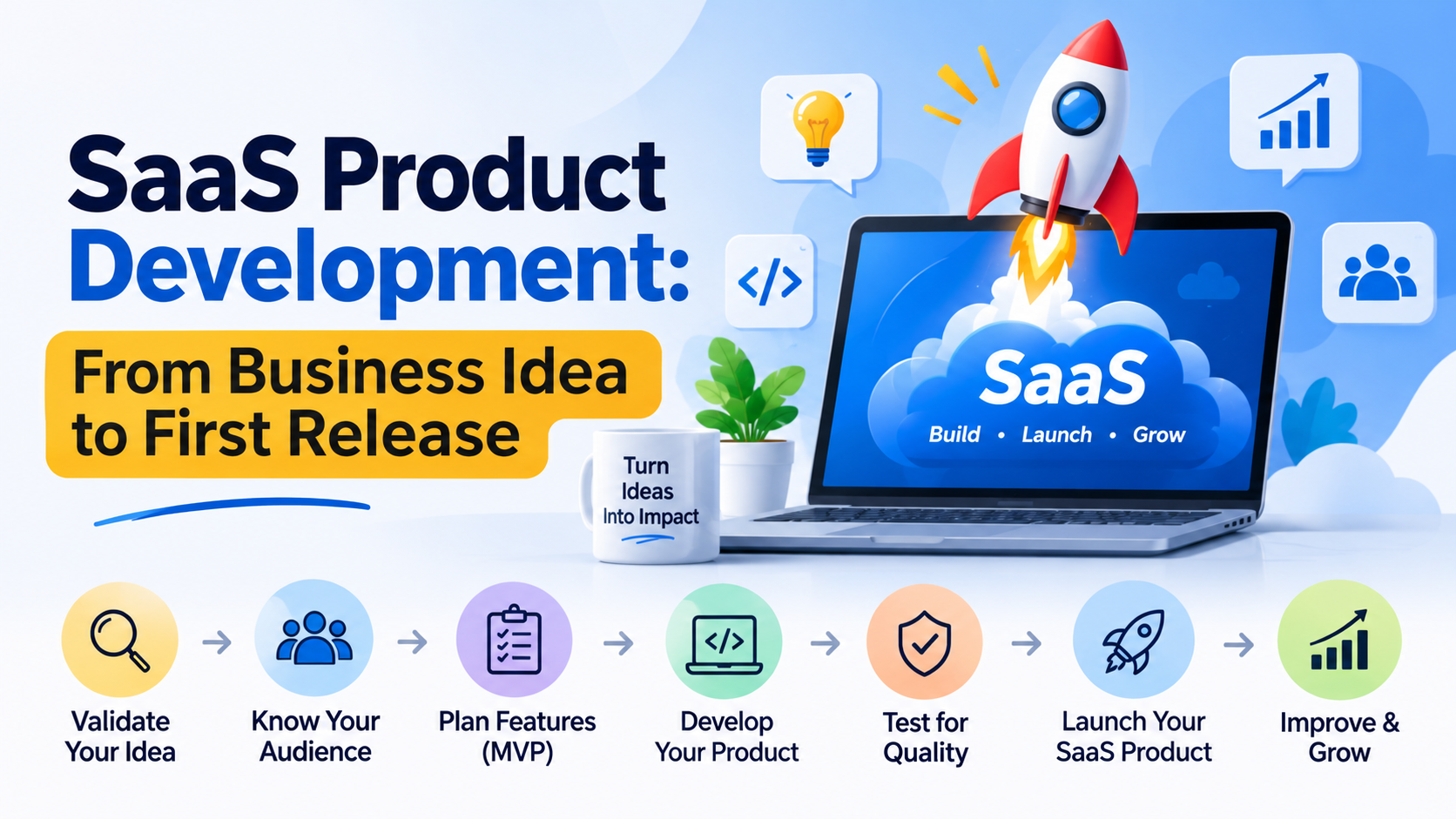
Turning a business idea into a working software product requires more than just writing code. Businesses need to understand their target audience, identify real problems, plan the right features, choose suitable technologies, and build a product that can grow over time.
This is where SaaS product development comes into play.
Software as a Service (SaaS) allows users to access software through the internet, usually through a subscription-based model. Instead of installing applications locally, customers can use SaaS platforms through a web browser or mobile application.
From project management tools and CRM platforms to accounting software and online booking systems, SaaS products have become an important part of modern business operations.
However, developing a successful SaaS product requires a structured approach. In this guide, we will explore the complete SaaS product development process, from validating an initial business idea to releasing the first version of your product.
Every successful SaaS product begins with a problem worth solving.
Before investing in development, businesses should identify the specific challenge their product will address. Building software without understanding customer requirements can result in unnecessary features, low adoption, and wasted development resources.
Start by asking:
For example, a business may notice that small logistics companies struggle to manage deliveries, track drivers, and communicate shipment updates. This could become an opportunity to develop a SaaS-based logistics management platform.
The goal is to identify a genuine business opportunity rather than simply creating another software application.
Once you have an idea, the next step is to determine whether there is actual demand for it.
Market validation helps businesses understand customer expectations, identify competitors, and evaluate the commercial potential of a SaaS product.
Some practical validation methods include:
Customer Interviews: Speak with potential users to understand their challenges, expectations, and existing workflows.
Competitor Research: Study similar SaaS platforms to identify their features, pricing models, strengths, and limitations.
Surveys: Collect feedback from potential customers to understand which features they value most.
Landing Page Testing: Create a simple landing page explaining the proposed product and measure interest through sign-ups or demo requests.
Problem Validation: Confirm that the problem is important enough for customers to invest in a solution.
Market validation does not guarantee product success, but it helps reduce the risk of building something customers do not need.
A SaaS product should be designed around the needs of its intended users.
For example, a SaaS CRM platform for small businesses may require simple contact management, lead tracking, and follow-up reminders. An enterprise CRM may need advanced reporting, role-based permissions, workflow automation, and third-party integrations.
Defining the target audience helps determine the product’s technical and functional requirements.
At this stage, document:
Creating a Software Requirements Specification (SRS) document can help development teams understand the expected functionality and technical scope before development begins.
One common mistake businesses make is trying to include every possible feature in the first release.
Instead, focus on developing a Minimum Viable Product (MVP).
An MVP is the initial version of a product that includes enough functionality to solve the primary customer problem and collect meaningful user feedback.
Depending on the product type, essential SaaS MVP features may include:
| Feature | Purpose |
|---|---|
| User Registration | Allows customers to create accounts |
| Login and Authentication | Provides secure account access |
| User Dashboard | Displays important information and activities |
| Subscription Management | Handles plans, billing, and payments |
| Core Product Functionality | Solves the primary customer problem |
| Admin Panel | Helps administrators manage users and settings |
| Notifications | Keeps users informed about important activities |
| Basic Reporting | Provides insights into product usage |
Not every SaaS product requires all these features in its first release.
Prioritize features based on customer requirements, business value, development complexity, and available budget.
Technology selection plays an important role in SaaS product development.
The technology stack should support the product’s functionality, security requirements, expected user traffic, and future expansion.
Some commonly used technologies include:
| Technology | Common Use |
|---|---|
| React.js | Interactive frontend development |
| Next.js | Modern web applications and server-side rendering |
| Laravel | Backend development and API creation |
| Node.js | Scalable backend applications |
| Python | Data processing and AI-powered functionality |
| PostgreSQL | Relational database management |
| MongoDB | Flexible document-based data storage |
| AWS | Cloud infrastructure and deployment |
| Docker | Application containerization |
The right technology depends on the product’s requirements rather than popularity alone.
For example, a SaaS application requiring complex business workflows may benefit from Laravel, while a real-time collaboration platform may require Node.js and WebSocket-based communication.
Working with an experienced software development team can help businesses select an architecture that balances development speed, performance, maintenance, and scalability.
A SaaS product should be easy to understand and navigate.
Even a feature-rich platform can struggle to attract and retain customers if users find it difficult to complete basic tasks.
UI/UX design should focus on simplifying the user journey and making important functionality accessible.
The design process generally includes:
User Flow Mapping: Define how users will move between different sections of the application.
Wireframing: Create basic layouts to establish the structure of important screens.
UI Design: Develop the visual elements, including typography, colors, buttons, forms, and navigation.
Interactive Prototyping: Create clickable prototypes to demonstrate how the application will work.
Usability Testing: Collect feedback to identify confusing layouts or unnecessary steps.
For example, a project management SaaS platform should allow users to create projects, assign tasks, monitor progress, and collaborate without navigating through complicated menus.
A well-designed interface improves usability and helps customers understand the product’s value.
Once requirements, technology, and design are finalized, the actual development process begins.
SaaS development generally involves frontend development, backend development, database architecture, API integration, and cloud infrastructure setup.
Frontend Development
The frontend is the part of the application users interact with. Developers build dashboards, forms, navigation menus, account settings, and other interface components.
Backend Development
The backend manages application logic, user authentication, data processing, permissions, and communication between different application components.
Database Development
A properly structured database stores customer information, subscription details, application records, and other essential data.
API Development and Integration
APIs allow different software components and external services to communicate. They are useful for integrating payment gateways, email services, analytics tools, and third-party applications.
Cloud Infrastructure Setup
Cloud infrastructure supports application hosting, storage, backups, monitoring, and deployment.
For SaaS platforms, development teams should also consider multi-tenancy architecture. This allows multiple customers to use the same application infrastructure while keeping their data appropriately separated.
Development should ideally happen in manageable sprints, allowing teams to review progress and address issues throughout the project.
Security and billing are two important components of a subscription-based software product.
Customers expect their information to remain protected, while businesses need a reliable way to manage recurring revenue.
Important security considerations include:
Subscription management should also be planned carefully.
Common billing features include:
Payment gateways such as Stripe and other region-supported payment providers can help automate subscription payments.
Businesses should also establish clear policies for customer data, billing, cancellation, and refunds.
Before releasing the SaaS application, it is important to verify that all major features work as expected.
Testing helps identify technical issues, usability problems, security weaknesses, and performance limitations.
A comprehensive testing process should include:
| Testing Type | What It Checks |
|---|---|
| Functional Testing | Whether features work correctly |
| UI Testing | Whether interface elements behave as expected |
| Performance Testing | Application speed and response time |
| Security Testing | Potential vulnerabilities and access issues |
| Compatibility Testing | Performance across browsers and devices |
| Integration Testing | Communication between application components |
| User Acceptance Testing | Whether the product meets user expectations |
Businesses should also test important customer journeys, such as account registration, login, subscription purchases, password recovery, and account cancellation.
A limited beta release can help collect feedback from real users before making the product publicly available.
After development and testing, the product is ready for its first release.
However, launching a SaaS application involves more than deploying code to a server.
Before launch, ensure that the following areas are ready:
A successful first release should focus on delivering a stable experience to early customers.
Businesses should avoid making unnecessary changes immediately before launch and should have a rollback plan in case critical issues occur.
Once the product is live, monitor user activity, technical performance, customer feedback, and subscription behavior.
The first release is not the end of SaaS product development. It is the beginning of continuous improvement.
Real customer usage often reveals problems and opportunities that may not appear during initial planning.
Businesses should regularly monitor:
For example, if users frequently abandon the registration process, the onboarding experience may need improvement. If customers repeatedly request a particular integration, it may become a priority for the next development cycle.
An iterative development approach allows businesses to introduce improvements based on actual customer needs rather than assumptions.
Even a promising SaaS idea can face challenges if the development process is not planned properly.
Here are some common mistakes businesses should avoid:
1. Building Too Many Features Initially
Adding unnecessary features increases development time and complexity. Start with the functionality that solves the primary customer problem.
2. Ignoring Market Research
Developing a product without understanding customer demand can result in low adoption.
3. Choosing Technology Without Considering Future Needs
The technology stack should support both current requirements and expected product growth.
4. Overlooking Security
Weak authentication, poor access controls, and inadequate data protection can damage customer trust.
5. Ignoring User Experience
Complicated navigation and confusing workflows can discourage customers from using the platform.
6. Skipping Proper Testing
Launching without adequate testing can lead to application errors, payment issues, and customer dissatisfaction.
7. Treating Launch as the Final Step
SaaS products require ongoing maintenance, monitoring, improvements, and customer support.
Avoiding these mistakes helps businesses establish a stronger foundation for long-term product growth.
SaaS product development is a structured journey that transforms a business idea into a functional, market-ready software solution.
From identifying a customer problem and validating market demand to defining MVP features, selecting the right technology, designing the interface, and launching the first release, every stage contributes to the product’s success.
The key is to start with a clear objective, prioritize essential functionality, and build a product that can evolve with customer requirements.
Whether you are planning a new SaaS startup or expanding your existing business with subscription-based software, working with an experienced development team can help simplify the process.
Looking to turn your SaaS idea into a working product? TechieDom provides web development, custom software development, UI/UX design, and application development services to help businesses plan, build, and launch digital solutions.
Visit TechieDom to explore how the right development approach can help bring your software idea to life.
1. What is SaaS product development?
SaaS product development is the process of planning, designing, building, testing, and launching cloud-based software that customers can access through the internet, usually through a subscription model.
2. How long does it take to develop a SaaS product?
Development time depends on product complexity, required features, integrations, and team size. A simple MVP may take approximately 2–4 months, while more complex SaaS platforms can require 6–12 months or longer.
3. What is an MVP in SaaS development?
A Minimum Viable Product (MVP) is the first functional version of a SaaS application. It includes essential features that solve the primary customer problem and helps businesses collect feedback before investing in additional functionality.
4. Which technology is best for SaaS product development?
There is no single best technology. React, Next.js, Laravel, Node.js, Python, PostgreSQL, and AWS are commonly used, depending on the application’s requirements and architecture.
5. How much does SaaS product development cost?
The cost depends on features, design complexity, integrations, security requirements, infrastructure, and development resources. A clearly defined MVP scope helps businesses estimate the initial investment more accurately.
6. Can an existing business convert its software into a SaaS product?
Yes. Existing business software can be redesigned or re-architected as a SaaS platform by introducing cloud hosting, customer account management, subscription billing, secure data separation, and scalable infrastructure.
7. What happens after the first SaaS product release?
After launch, businesses should monitor application performance, collect customer feedback, fix issues, improve existing features, and introduce new functionality based on user requirements.