
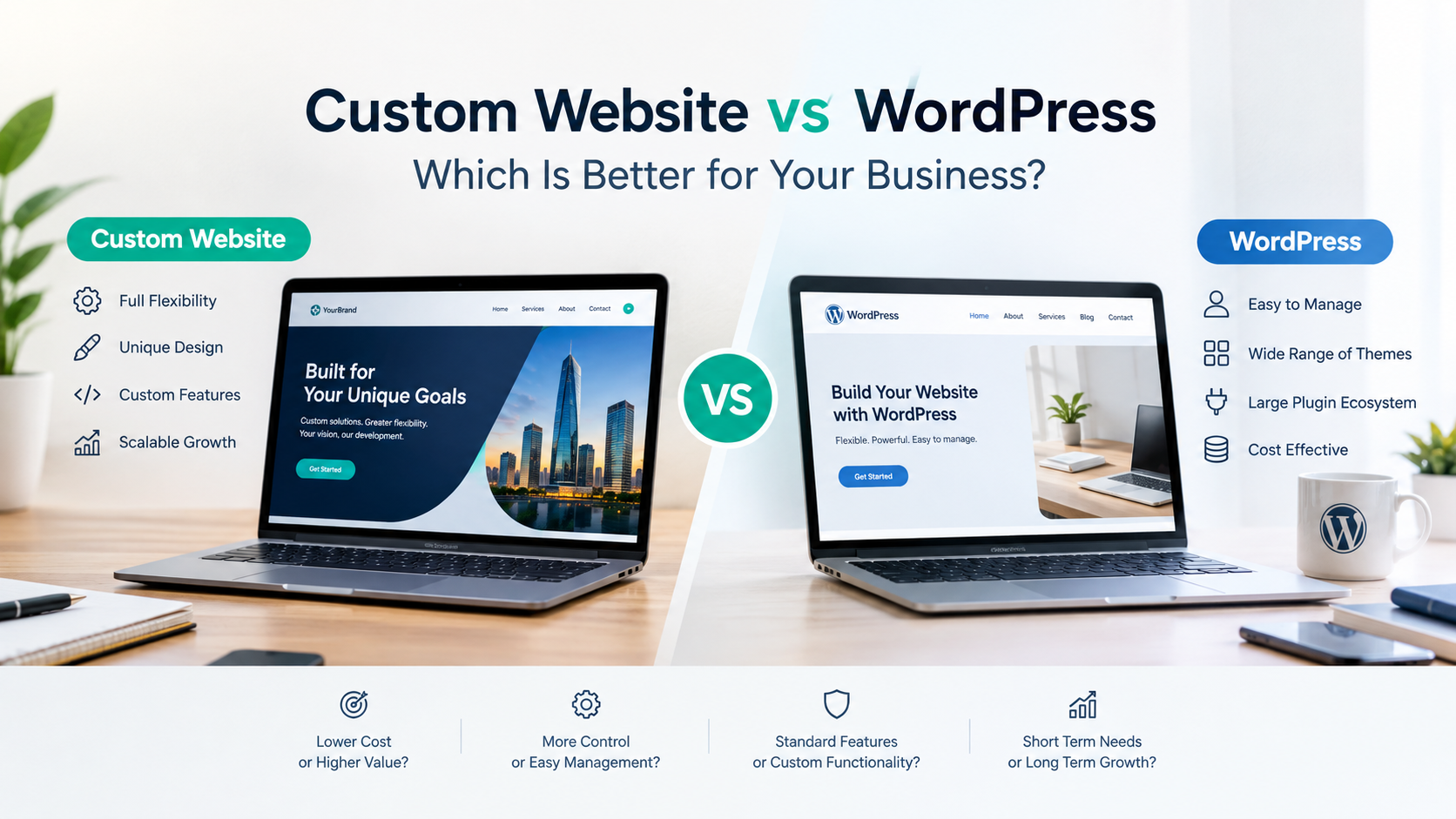
Choosing the right technology for your business website can be challenging. WordPress is one of the most widely used content management systems, while a custom website can be built specifically around your business requirements.
Both approaches have advantages. The better choice depends on factors such as your budget, website goals, required functionality, scalability, maintenance resources, and how much customization you need.
Before starting a website project, it is important to understand the differences between a custom website and a WordPress website.
In this guide, we’ll compare both options to help you determine which approach may be better for your business.
WordPress is a content management system (CMS) that allows businesses to create, manage, and update website content.
A WordPress website can be built using themes, plugins, custom development, or a combination of these approaches.
Businesses commonly use WordPress for:
One of the major advantages of WordPress is that businesses can manage content without requiring extensive technical knowledge.
However, the quality and performance of a WordPress website depend heavily on how it is designed, developed, configured, and maintained.
A custom website is developed specifically around the requirements of a business rather than relying primarily on a pre-built theme or standard website structure.
The design, functionality, user experience, integrations, and technical architecture can be tailored to specific requirements.
Custom development can be useful when a business needs:
A custom website does not necessarily mean building everything from scratch. Developers can use established technologies and frameworks while creating functionality specifically for the business.
Let’s compare the two approaches across the factors that matter most to businesses.
One of the first considerations for most businesses is development cost.
WordPress can be more economical for businesses that need a relatively standard website. Existing themes, plugins, and CMS functionality can reduce development time.
However, costs can increase when you require:
Custom development generally requires more planning and development work, particularly when the website has unique functionality.
The initial investment may therefore be higher.
However, the cost should be evaluated against the business value and long-term requirements rather than simply comparing the initial development price.
Best option: WordPress can be suitable when keeping initial development requirements straightforward is important. Custom development may make more sense when specialized functionality is central to the business.
WordPress offers thousands of themes and design options. Developers can also customize themes to create a more distinctive website.
For many businesses, this provides enough flexibility.
However, heavily modifying an existing theme can sometimes become difficult to maintain.
Custom development provides greater control over the design and user experience.
Every major component can be designed around the target audience and business objectives instead of adapting the business to a pre-existing theme structure.
Best option: Custom website development generally offers greater design flexibility.
This is one of the biggest differences between the two approaches.
WordPress supports a large ecosystem of plugins, making it possible to add functionality without developing everything from scratch.
For example, businesses can add:
However, relying heavily on plugins can create compatibility, performance, or maintenance considerations.
A custom website can be designed around specific functionality from the beginning.
If your business requires a highly specialized workflow that standard WordPress functionality cannot efficiently support, custom development may be a better fit.
Your website requirements may change as your business grows.
A small company may initially need only a few service pages, a contact form, and a blog. Later, it might require customer accounts, integrations, advanced reporting, or custom workflows.
WordPress can scale successfully when it is properly developed and maintained. Hosting, database configuration, caching, media optimization, plugins, and code quality all affect performance.
Custom development can provide more control over the architecture and functionality as requirements become more complex.
Best option: Both can scale, but custom development may be more suitable when your future requirements involve highly specialized functionality.
Neither WordPress nor custom development automatically guarantees better SEO.
SEO performance depends on the quality of the website, content, technical implementation, user experience, authority, and ongoing optimization.
A properly developed WordPress website can provide a strong foundation for SEO.
A custom website can also be built with SEO requirements incorporated from the beginning.
Important SEO considerations include:
Best option: The development approach matters less than whether SEO requirements are properly implemented.
WordPress provides an administrative interface that allows non-technical users to create and edit content.
This can be particularly useful for businesses that regularly publish:
A custom website can also include a CMS, but the content management experience depends on the system selected and how it is developed.
Best option: WordPress is often convenient for businesses that want a familiar CMS experience, while a custom CMS can be designed around specific workflows.
Every website requires maintenance, regardless of the technology used.
For WordPress, businesses need to keep the core platform, themes, plugins, and integrations properly maintained.
Poorly maintained plugins or outdated software can create security and compatibility issues.
Custom websites also require security updates, server maintenance, monitoring, backups, and ongoing technical support.
The security of either approach depends on implementation, hosting, configuration, maintenance, and development practices.
Best option: Choose the approach your team can properly maintain and support over the long term.
Website performance affects user experience and can influence SEO.
WordPress websites can perform very well when they are properly optimized.
However, excessive plugins, poorly coded themes, large media files, inefficient scripts, or unsuitable hosting can negatively affect performance.
A custom website gives developers greater control over the code and functionality being delivered.
But custom development does not automatically mean a faster website. Poorly developed custom code can also create performance problems.
Best option: Evaluate the actual implementation rather than assuming one technology is always faster.
WordPress may be a good choice if your business needs:
For example, a consulting company that needs service pages, a blog, case studies, lead forms, and basic integrations may not need a fully custom website.
WordPress can provide an efficient foundation for this type of project.
Custom development may be more appropriate if your business requires:
For example, a business that needs a customer portal connected to its internal systems may benefit from a custom development approach.
Yes.
Choosing WordPress does not necessarily mean you have to use only pre-built themes and plugins.
A WordPress website can include custom:
This hybrid approach can provide the convenience of WordPress while allowing developers to build functionality specific to the business.
For many businesses, this can be a practical middle ground.
Custom Website vs WordPress: Comparison Table
Instead of asking, “Which technology is better?” start by asking, “What does my business actually need?”
Consider these questions:
Is it primarily for:
If your website requirements are relatively standard, WordPress may be sufficient.
If your business depends on unique functionality, custom development may be more appropriate.
If your marketing team needs to publish and update content frequently, a user-friendly CMS should be an important consideration.
Think beyond the initial launch.
Will you eventually need:
Your future plans can influence the technology decision.
Consider who will handle updates, security, backups, performance monitoring, bug fixes, and future development.
The right website solution depends on your business objectives rather than simply choosing between WordPress and custom development.
TechieDom can support businesses with:
Build business websites around specific goals, functionality, and target audiences.
Create user-focused interfaces and website experiences designed around usability and conversion objectives.
Develop specialized software and digital solutions for businesses with unique operational requirements.
Build and optimize online stores for businesses selling products online.
Develop or integrate systems that help businesses manage content, customers, and workflows.
Build SEO considerations into website planning and support ongoing organic growth.
Help businesses turn validated product ideas into focused minimum viable products for early testing.
The right combination of services depends on the complexity and goals of your project.
Neither is universally better. WordPress can be an excellent choice for many business websites, while custom development can be more suitable for businesses with specialized functionality or complex workflows.
It can be, particularly when extensive custom functionality is required. However, the total cost depends on the project’s scope, technology, integrations, design, maintenance, and long-term requirements.
Yes. WordPress can provide a strong foundation for SEO when the website is properly structured, optimized, maintained, and supported with high-quality content.
Yes. Developers can customize WordPress themes, plugins, templates, integrations, and functionality according to business requirements.
Not necessarily. Both can be fast when properly developed and optimized. Website performance depends on factors such as code quality, hosting, images, scripts, databases, and overall implementation.
For many small businesses with standard website requirements, WordPress can be a practical option. A custom solution may be justified when the business requires functionality that standard WordPress implementations cannot efficiently provide.
| Factor | WordPress | Custom Website |
| Initial development | Often simpler for standard requirements | Usually more development-intensive |
| Design flexibility | High with customization | Very high |
| Content management | Strong | Depends on CMS |
| Plugins/integrations | Large ecosystem | Built around requirements |
| Custom functionality | Possible | Excellent |
| Scalability | Good with proper architecture | Highly flexible |
| Maintenance | Requires CMS/plugin updates | Requires technical maintenance |
| SEO | Strong when properly implemented | Strong when properly implemented |
| Best for | Standard business/content websites | Specialized and complex requirements |
The choice between a custom website and WordPress should be based on your business requirements, not technology trends.
WordPress can be an effective and flexible solution for businesses that need a professional website, content management, e-commerce functionality, or a relatively straightforward digital presence.
Custom development becomes more attractive when your business requires specialized functionality, complex integrations, unique workflows, or a highly tailored digital product.
In some cases, the best solution is a combination of WordPress and custom development.
Before starting the project, define your goals, required functionality, budget, maintenance capabilities, and long-term plans. Then choose the technology that provides the right balance of flexibility, usability, performance, and scalability.
Need help choosing the right approach for your business website? Talk to TechieDom about your requirements and explore whether WordPress, custom development, or a hybrid solution is the right fit.