
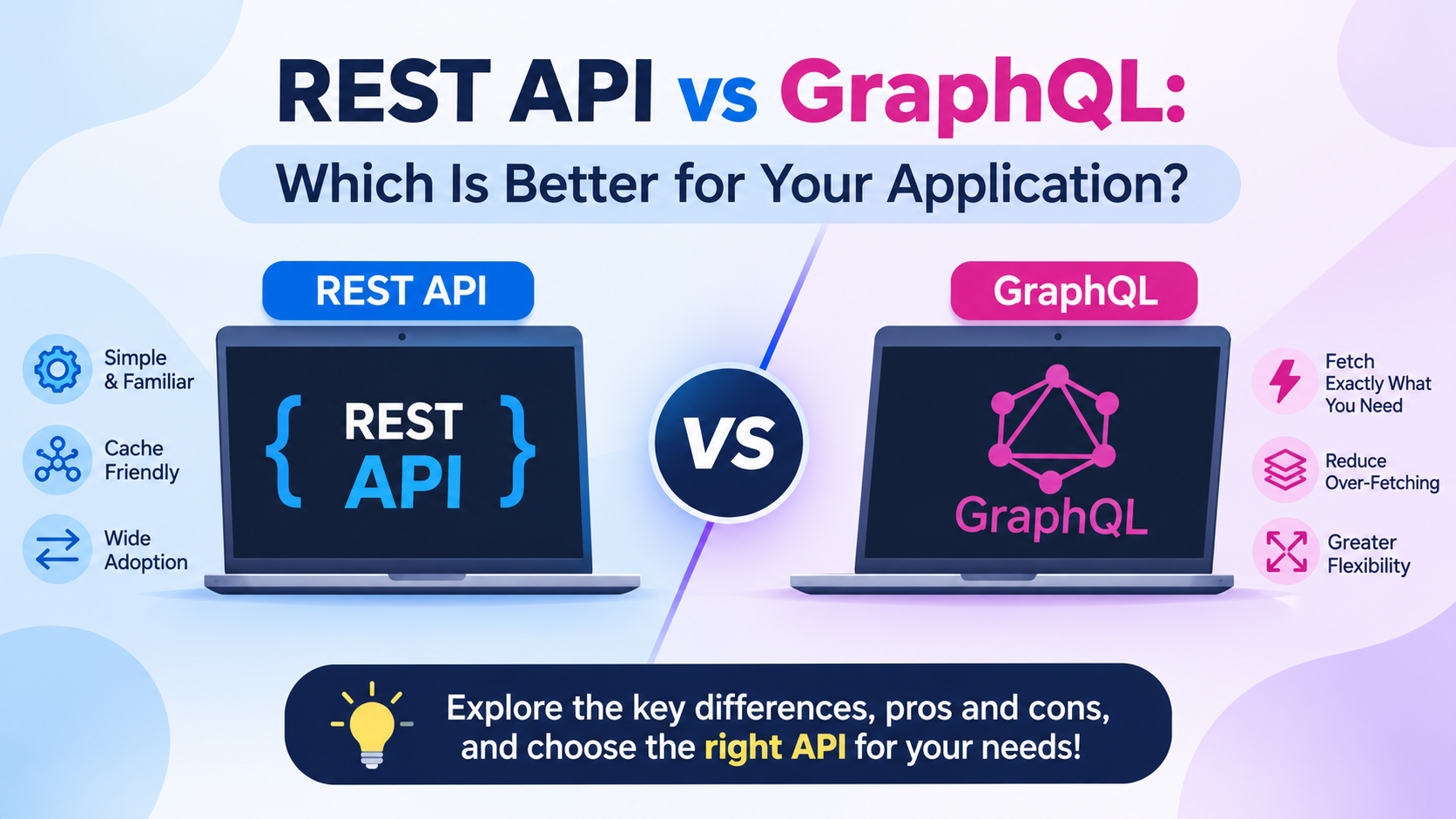
Modern applications rely on APIs to exchange data between frontend interfaces, backend systems, databases, and third-party services. Whether you are developing a mobile application, SaaS platform, ecommerce website, or enterprise software, choosing the right API architecture can significantly influence application performance and scalability.
Two popular approaches to API development are REST API and GraphQL.
REST has been widely used for building web services because of its simplicity, standardized HTTP methods, and straightforward resource-based architecture. GraphQL, developed by Meta, provides a more flexible approach by allowing clients to request exactly the data they need through a single endpoint.
But which one is better for your application?
The answer depends on your project requirements, data structure, application complexity, development resources, and long-term goals.
In this guide, we will compare REST API vs GraphQL across important technical and business considerations to help you make the right decision.
REST stands for Representational State Transfer. It is an architectural style used to design network-based applications and web services.
REST APIs allow different software systems to communicate through HTTP requests. They organize application data into resources, with each resource generally accessible through a specific URL endpoint.
REST commonly uses the following HTTP methods:
| HTTP Method | Purpose | Example |
|---|---|---|
| GET | Retrieve data | Get customer details |
| POST | Create new data | Add a new customer |
| PUT | Replace an existing resource | Update customer information |
| PATCH | Partially update a resource | Change customer email |
| DELETE | Remove a resource | Delete a customer |
For example, an ecommerce application might use separate REST endpoints:
/api/products – Retrieve product listings./api/products/101 – Retrieve a specific product./api/customers – Manage customer information./api/orders – Access order details./api/orders/501 – Retrieve a specific order.Each endpoint performs a defined operation, making REST APIs relatively easy to understand, implement, and maintain.
Key Advantages of REST APIs
REST is often a practical choice for applications with clearly defined resources and predictable data requirements.
GraphQL is a query language and runtime for APIs that allows clients to request specific data from a server.
Unlike traditional REST APIs, which often use multiple endpoints, GraphQL typically exposes a single endpoint through which clients can request different combinations of data.
One of its biggest advantages is flexibility.
For example, imagine a mobile application displaying customer information along with recent orders. With REST, the application might need separate requests to retrieve customer details and order information.
With GraphQL, the client can request both through a single query.
Example GraphQL Query:
query {
  customer(id: "101") {
    name
    email
    orders {
      orderId
      totalAmount
      status
    }
  }
}
The server returns only the requested fields.
This approach can reduce unnecessary data transfer and simplify frontend data requirements, particularly when applications have complex relationships between different data types.
Key Advantages of GraphQL
GraphQL is particularly useful for applications where different clients require different combinations of data.
Although both technologies help applications exchange data, they follow different approaches to API design and data retrieval.
Here is a direct comparison:
| Comparison Factor | REST API | GraphQL |
|---|---|---|
| Architecture | Resource-based | Query-based |
| Endpoints | Multiple endpoints | Typically a single endpoint |
| Data Fetching | Defined by endpoints | Defined by client queries |
| Over-fetching | Can occur | Reduced through field selection |
| Under-fetching | May require multiple requests | Can often be avoided |
| HTTP Methods | GET, POST, PUT, PATCH, DELETE | Commonly POST |
| Caching | Established HTTP caching support | Requires additional caching strategies |
| Versioning | Often uses URL or header versioning | Schema evolution is commonly preferred |
| Error Handling | HTTP status codes | Often uses HTTP status codes and GraphQL error responses |
| Learning Curve | Generally easier | Requires understanding schemas and queries |
| Real-Time Data | Often uses WebSockets or other mechanisms | Supports subscriptions when implemented |
| Best Use Case | Standard resource-based applications | Complex data-driven applications |
Neither approach is universally better. The right choice depends on how your application consumes and manages data.
Performance is an important consideration when selecting an API architecture.
However, it is not accurate to assume that GraphQL is always faster than REST or vice versa.
Actual performance depends on database queries, server implementation, caching, network conditions, response size, and application architecture.
REST API Performance
REST APIs can perform efficiently because individual endpoints are designed around specific resources and operations.
For example, an application retrieving a product list can use a dedicated endpoint that returns only the information required for that operation.
REST also benefits from established HTTP caching mechanisms, which can improve response times for frequently requested resources.
However, when an application needs information from multiple resources, it may require several network requests.
GraphQL Performance
GraphQL allows clients to retrieve related information through a single query.
This can reduce the number of network requests and prevent unnecessary data transfer.
However, complex queries may place additional pressure on backend systems, particularly when they involve deeply nested relationships or expensive database operations.
Developers must implement query depth limits, complexity controls, pagination, and efficient data loading to avoid performance problems.
Which Should You Choose?
REST is often suitable when application requirements involve straightforward data retrieval and predictable API operations.
GraphQL may be beneficial when clients need flexible access to complex or interconnected data.
Caching helps applications reduce repeated database queries, improve response times, and manage server resources.
Both REST and GraphQL support caching, but their implementation approaches differ.
REST API Caching
REST works naturally with HTTP caching mechanisms.
Developers can use:
For example, a product listing that changes infrequently can be cached to reduce unnecessary requests to the backend.
GraphQL Caching
GraphQL typically uses a single endpoint, which makes traditional URL-based caching less straightforward because different queries may be sent to the same URL.
However, developers can implement:
GraphQL caching can be highly effective, but it generally requires more deliberate implementation.
API security should be considered from the beginning of application development.
Both REST and GraphQL can support secure authentication and authorization, but each requires appropriate implementation.
REST API Security
Common security practices include:
Developers should ensure that every endpoint verifies whether the requesting user has permission to access or modify the requested resource.
GraphQL Security
GraphQL requires additional attention because clients can construct flexible and potentially complex queries.
Important security practices include:
For example, a user should not be able to access another customer’s private information simply by changing an ID in a GraphQL query.
Regardless of the architecture, security must be implemented at the server and data-access levels rather than relying only on frontend restrictions.
As an application grows, its API architecture must support additional users, features, integrations, and data requirements.
REST API Scalability
REST works well with distributed architectures and microservices.
Individual endpoints can be optimized, monitored, and scaled based on their workloads.
Its resource-based structure also makes it easier for development teams to organize API functionality around business entities.
GraphQL Scalability
GraphQL can simplify data access for applications with multiple frontend clients, such as web applications, mobile applications, and admin dashboards.
However, maintaining a GraphQL API requires careful schema management, resolver optimization, authorization, and query monitoring.
As the application expands, developers must ensure that complex queries do not create database bottlenecks.
The best architecture is one that matches the application’s expected growth and can be maintained efficiently by the development team.
REST is a strong option for applications with predictable data structures and clearly defined operations.
Consider REST API development when:
1. Building Ecommerce Applications
Product listings, shopping carts, orders, payment processing, and customer management can be organized into dedicated REST endpoints.
2. Developing Business Applications
Inventory management, employee management, CRM systems, and accounting platforms often benefit from resource-based API structures.
3. Creating Microservices
REST provides a straightforward way for independent services to communicate through HTTP.
4. Building Public APIs
REST is widely understood and can be easier for external developers to integrate with.
5. Working With Standard CRUD Operations
Applications that frequently create, retrieve, update, and delete records can work effectively with REST.
GraphQL can be a better fit when applications require flexible data retrieval and complex relationships between resources.
Consider GraphQL when:
1. Developing Complex SaaS Platforms
SaaS dashboards often combine customer information, subscriptions, reports, notifications, and activity data. GraphQL can allow clients to retrieve these related details through flexible queries.
2. Building Mobile Applications
Mobile applications may benefit from requesting smaller, specific datasets, particularly when network connectivity or bandwidth is limited.
3. Managing Multiple Frontend Applications
If a business operates web, mobile, and admin applications that need different data combinations, GraphQL can reduce the need for separate specialized endpoints.
4. Creating Data-Intensive Dashboards
Analytics platforms and reporting applications often require information from multiple related data sources.
5. Working With Frequently Changing Data Requirements
GraphQL allows frontend teams to request new fields without necessarily requiring a new endpoint for every change.
Yes. Businesses do not always need to choose only one API architecture.
REST and GraphQL can coexist within the same application.
For example, an ecommerce platform might use:
Another approach is to use GraphQL as an API gateway that connects multiple backend services, including existing REST APIs.
This hybrid architecture can help businesses use the strengths of both approaches.
However, developers should avoid introducing unnecessary complexity. Each API layer should have a clearly defined purpose and consistent security policies.
Before selecting REST or GraphQL, evaluate your application’s technical and business requirements.
Consider these important factors:
| Decision Factor | Consider REST When | Consider GraphQL When |
|---|---|---|
| Data Structure | Resources are straightforward | Data relationships are complex |
| Frontend Requirements | Data needs are predictable | Different clients need different fields |
| Caching | HTTP caching is a priority | Custom query-aware caching is acceptable |
| Development Complexity | Simplicity is preferred | Flexible data retrieval is important |
| Application Type | CRUD-based business applications | Data-intensive dashboards and SaaS platforms |
| Existing Infrastructure | REST services already exist | A flexible API layer is required |
| Team Expertise | Team has REST experience | Team understands schemas and resolvers |
It is also important to consider development cost, infrastructure requirements, maintenance responsibilities, and the team’s technical capabilities.
Choosing an API architecture based on actual requirements can help avoid unnecessary development work and future migration challenges.
Regardless of whether you choose REST or GraphQL, certain development mistakes can affect application performance and security.
Here are some common issues to avoid:
Following established API development practices helps create reliable and maintainable applications.
REST API and GraphQL are both effective approaches to modern application development, but they solve data communication challenges in different ways.
REST offers simplicity, predictable endpoints, and established HTTP caching mechanisms, making it suitable for traditional web applications, business software, ecommerce platforms, and microservices.
GraphQL provides flexible data retrieval, making it useful for complex SaaS platforms, mobile applications, and systems where multiple frontend clients require different data structures.
The right choice depends on your application’s requirements, data relationships, performance expectations, security needs, and long-term development strategy.
At TechieDom, we help businesses plan and develop custom software solutions, web applications, and API-driven platforms. Whether your project requires REST API development, GraphQL integration, or a hybrid architecture, selecting the right technical approach is essential for building reliable digital products.
Visit TechieDom to explore software development solutions for your business.