
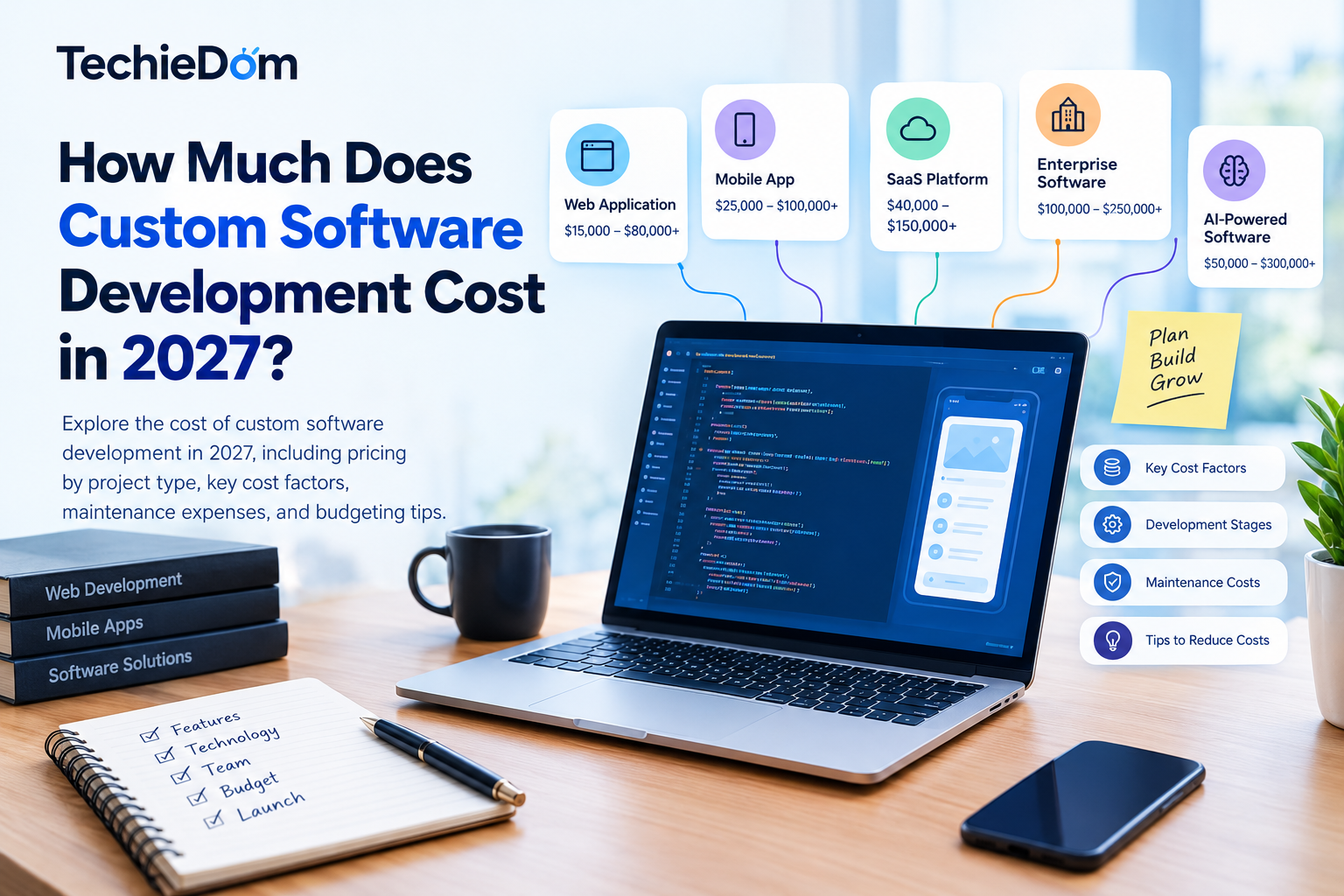
Custom software development can cost anywhere from $10,000 to $250,000 or more in 2027, depending on the project’s complexity, required features, technology stack, development team, and long-term business goals. Simple business applications may require a smaller investment, while complex enterprise platforms, SaaS products, and software powered by artificial intelligence can cost significantly more.
For businesses in the USA, understanding the cost of custom software development before starting a project helps with budgeting, prioritizing features, and choosing the right development partner.
Whether you want to build an internal business tool, a customer-facing application, an enterprise platform, or a software-as-a-service (SaaS) product, this guide explains the expected costs, major pricing factors, and ways to manage your software development budget in 2027.
The cost of custom software development depends primarily on the scope and complexity of the project. A small application with a few essential features requires less time and resources than a large platform with multiple integrations, advanced security, and complex workflows.
The following figures are indicative planning estimates, not fixed industry prices or guaranteed 2027 rates.
| Software Type | Estimated Cost in 2027 |
|---|---|
| Basic business software | $10,000–$30,000 |
| Small custom web application | $15,000–$40,000 |
| Medium-complexity software | $30,000–$80,000 |
| Custom mobile application | $25,000–$100,000+ |
| SaaS platform development | $40,000–$150,000+ |
| Enterprise software solution | $100,000–$250,000+ |
| AI-powered custom software | $50,000–$300,000+ |
Actual costs may fall below or above these ranges. A simple AI integration may cost considerably less than developing a sophisticated AI platform, while a mobile application with separate iOS and Android builds may require a larger budget.
The best way to estimate your project’s cost is to define its requirements, identify essential features, and obtain a detailed development proposal.
Several factors influence how much you will pay to develop custom software. Understanding these variables makes it easier to plan your budget and avoid unexpected expenses.
The number and complexity of features directly affect development time and cost.
For example, a basic inventory management system may include product records, stock tracking, and simple reports. A more advanced system could require automated purchase orders, supplier integrations, forecasting, multiple warehouse management, and real-time analytics.
Common features that affect software development costs include:
Starting with essential features can help businesses launch sooner and expand the software as their requirements grow.
User interface (UI) and user experience (UX) design determine how the software looks, feels, and functions for its users.
A straightforward internal tool may need a relatively simple interface. A customer-facing application or SaaS dashboard may require detailed user research, wireframes, interactive prototypes, usability testing, and custom visual design.
Investing in good UI/UX design can reduce usability problems, improve adoption, and make the software easier to maintain as the product evolves.
The technology stack includes the programming languages, frameworks, databases, and infrastructure used to develop the software.
Depending on the requirements, a development team might use technologies such as React, Node.js, Laravel, Python, or cloud-based services.
The right technology stack depends on factors such as scalability, security, integration requirements, developer availability, and long-term maintenance. Choosing a technology solely because it has a lower initial development cost may create additional expenses later.
Development rates vary by location, experience, specialization, and engagement model.
Businesses in the USA may choose a domestic development team, an offshore development company, or a hybrid model that combines local project management with offshore engineering resources.
An offshore team can offer cost advantages, but businesses should also evaluate communication, technical expertise, project management, security practices, and post-launch support.
The lowest hourly rate does not necessarily result in the lowest total project cost. An experienced team that delivers reliable software with fewer defects may provide better long-term value.
Custom software often needs to work with existing business systems, including CRM platforms, accounting tools, payment processors, ERP software, and marketing automation platforms.
Integrating these systems may require API development, authentication, data mapping, error handling, and extensive testing.
Moving information from legacy systems into a new platform can also increase costs, especially when the data is inconsistent, duplicated, or stored in outdated formats.
Security requirements can significantly influence the cost of software development, particularly when applications process financial, customer, employee, or other sensitive information.
Depending on the industry and use case, a project may require:
Businesses should define their security and compliance requirements early instead of treating them as optional additions after development is complete.
Different software projects have different technical requirements, development timelines, and budgets.
Estimated cost: $15,000–$80,000+
Custom web applications help businesses automate operations, manage information, and provide online services.
Examples include booking platforms, employee management systems, customer portals, inventory dashboards, and workflow automation tools.
The final cost depends on user roles, database complexity, integrations, reporting requirements, and the number of workflows.
Estimated cost: $25,000–$100,000+
Mobile applications may require separate development work for iOS and Android, or a cross-platform approach that shares much of the codebase.
Features such as location tracking, push notifications, in-app payments, messaging, and offline functionality can increase development time.
The budget should also account for app testing, deployment, compatibility updates, and ongoing maintenance.
Estimated cost: $40,000–$150,000+
A SaaS product allows customers to access software through a subscription or another online business model.
A typical SaaS platform may include user accounts, subscription billing, dashboards, role-based permissions, customer onboarding, and administrative tools.
More advanced products may need multi-tenant architecture, usage-based billing, advanced analytics, integrations, and enterprise-level security.
Businesses planning a SaaS launch can begin with a minimum viable product (MVP) that validates the core idea before investing in a larger feature set.
Estimated cost: $100,000–$250,000+
Enterprise software supports complex business operations across departments, locations, or large user groups.
Examples include enterprise resource planning systems, supply chain management platforms, advanced CRM solutions, and large-scale operational applications.
These projects typically require more extensive planning, permissions, integrations, testing, security controls, documentation, and implementation support.
Estimated cost: $50,000–$300,000+
AI-powered software can automate repetitive work, analyze information, generate content, improve search, and support business decision-making.
Costs vary considerably depending on whether the application integrates an existing AI model or requires custom model development, specialized data pipelines, evaluation systems, and advanced infrastructure.
Businesses should also budget for ongoing model usage, data processing, monitoring, and improvements after launch.
Software development costs are not limited to writing code. A complete project generally includes planning, design, development, testing, deployment, and ongoing support.
| Development Stage | Typical Share of Initial Budget |
|---|---|
| Discovery and planning | 5%–10% |
| UI/UX design | 10%–15% |
| Software development | 40%–55% |
| Quality assurance and testing | 10%–20% |
| Deployment and launch | 5%–10% |
These percentages are illustrative and may overlap depending on the development process and project structure.
For example, a software project with a $50,000 budget might allocate approximately $3,500 to planning, $6,000 to design, $25,000 to development, $10,000 to testing, and $5,500 to deployment.
The actual distribution depends on the project. Some applications require substantial design or security work, while others involve complex integrations and more development effort.
Software requires ongoing maintenance to remain secure, compatible, reliable, and useful as business requirements change.
A common preliminary budgeting guideline is to allocate approximately 15%–25% of the initial development cost per year for maintenance and improvements. This is a planning assumption rather than a universal industry rate.
For software that costs $50,000 to develop, that would mean budgeting around $7,500–$12,500 annually.
Ongoing expenses may include:
The actual maintenance budget depends on the software’s complexity, hosting requirements, usage, service agreements, and the pace of product development.
Reducing software development costs does not mean compromising on quality. It means making informed decisions about scope, technology, and project execution.
An MVP includes the core features needed to solve the primary business problem. Instead of building every planned feature at once, launch a smaller version and use real user feedback to guide future development.
This approach helps businesses validate demand before committing to a larger investment.
Separate requirements into three groups: essential, useful, and optional.
Focus the initial budget on essential functionality. Features such as advanced analytics, extensive customization, and complex automation can be added later when there is a clear business need.
Compare development partners based on technical capabilities, relevant experience, communication, delivery process, and maintenance support.
Ask for a detailed project scope, deliverables, estimated timeline, payment milestones, and an explanation of how change requests will be handled.
Existing frameworks, cloud services, payment integrations, and established software libraries can reduce development effort.
However, reusable components should be evaluated for security, compatibility, licensing, and long-term support before being included in a project.
Build the software to support realistic business needs and expected growth. Avoid paying for unnecessarily complex architecture before the product requires it.
A good development partner can help balance current requirements with future expansion.
Frequent changes to project requirements can increase costs and delay launch.
Document the main workflows, user roles, required integrations, performance expectations, and acceptance criteria before development begins. Clear requirements help the team estimate work more accurately.
Off-the-shelf software is often less expensive to adopt initially because the product already exists. Custom software requires a larger upfront investment but can be designed around specific business processes.
| Factor | Custom Software | Off-the-Shelf Software |
|---|---|---|
| Initial cost | Usually higher | Usually lower |
| Customization | High | Limited to available options |
| Deployment | Requires development | Often quicker to implement |
| Integrations | Can be tailored | Depends on vendor capabilities |
| Ongoing expenses | Maintenance and infrastructure | Subscriptions and add-ons |
| Ownership and control | Depends on contract and IP terms | Governed by vendor terms |
| Best suited for | Unique workflows and strategic products | Standard business requirements |
The right option depends on your business needs. If an existing product already meets your requirements, purchasing a subscription may be more practical.
If your business needs specialized workflows, proprietary features, or a product you intend to commercialize, custom software may offer greater long-term value.
Choosing the right development partner is an important part of managing software costs and achieving your business goals.
TechieDom can be positioned as a development partner for businesses seeking software solutions aligned with their operational needs, customer experience, and growth plans.
When evaluating a custom software development partner, look for a team that can help you:
Before starting a project, discuss your requirements, expected timeline, budget, and long-term goals with the development team.
Explore TechieDom’s software development services to discuss an approach that fits your project requirements.
Custom software development may cost around $10,000 for a relatively small project and exceed $250,000 for complex enterprise solutions. The actual cost depends on features, integrations, security requirements, technology choices, and development resources.
A small application may take a few weeks to several months, while a more complex platform can take six months to a year or longer. Timelines depend on scope, team size, integrations, testing, and feedback cycles.
Custom software can be worthwhile when it solves specific operational problems, automates repetitive tasks, improves customer experience, or creates a product that supports business growth. The expected return should be evaluated against development, maintenance, and operating costs.
Offshore development can reduce development expenses in some cases, depending on the team’s location, expertise, and engagement model. However, businesses should also consider project management, communication, quality assurance, security, and long-term support when comparing proposals.
Starting with a focused MVP is often a practical way to control initial costs. Prioritize essential features, use reliable existing technologies, define requirements clearly, and expand the product based on actual business needs.
Not necessarily. Some proposals include a limited warranty or post-launch support period, while ongoing maintenance is billed separately. Confirm hosting, third-party subscriptions, updates, support, and future enhancements before signing an agreement.
Prepare a description of the business problem, target users, essential features, required integrations, preferred platforms, security requirements, estimated budget, and desired launch date. A development partner may also recommend a discovery phase to clarify the scope before providing a detailed estimate.
Custom software development costs in 2027 will depend on what you need to build, how complex the requirements are, and the development approach you choose. A smaller business application may require tens of thousands of dollars, while an advanced SaaS or enterprise platform can require a significantly larger investment.
The best way to control costs is to define clear requirements, prioritize essential features, select an appropriate technology stack, and plan for maintenance from the beginning.
If you are considering a custom software project, TechieDom can help you explore development options aligned with your business requirements and long-term goals. Start by defining your software needs and discussing the scope with a development team to obtain a more accurate estimate.