

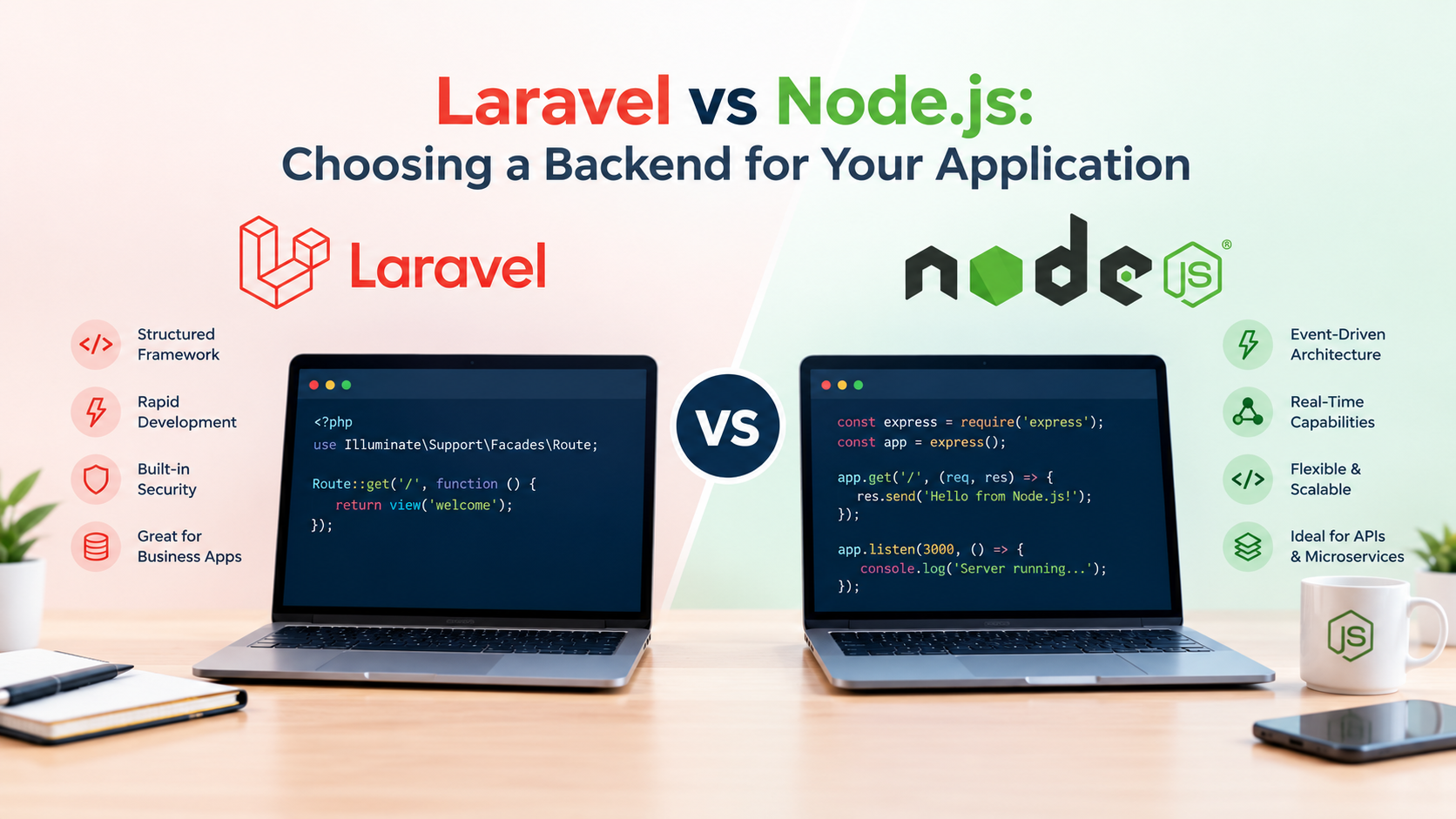
Choosing the right backend technology is an important decision when developing a web application. The backend handles business logic, processes requests, interacts with databases, manages authentication, and connects the application with external services.
Two popular options are Laravel and Node.js. Both can support modern web applications, but they approach backend development differently.
Laravel is a PHP framework that provides a structured environment for building web applications. Node.js is a JavaScript runtime that allows developers to execute JavaScript on the server, often using frameworks such as Express or NestJS.
So, which option should you choose for your project?
The answer depends on your application’s requirements, development team’s expertise, expected traffic, real-time functionality, integrations, and long-term plans.
In this guide, we compare Laravel vs Node.js across the key factors that can help you make an informed decision.
Laravel is an open-source PHP framework designed to simplify web application development. It provides a structured architecture and built-in tools that help developers create maintainable applications.
Laravel includes features for routing, database operations, authentication, request validation, background jobs, caching, and other common development tasks.
Businesses may use Laravel to build:
One of Laravel’s main advantages is its integrated development ecosystem. Instead of building every common feature from scratch, developers can use established framework capabilities and focus on the application’s business requirements.
Laravel can be particularly suitable for applications that benefit from a clear structure and conventional server-side workflows.
Node.js is a JavaScript runtime that enables developers to execute JavaScript outside the browser, including on web servers.
It uses an event-driven architecture and non-blocking I/O, making it well suited to applications that handle many concurrent connections and spend significant time waiting for network or database operations.
Node.js is commonly used with frameworks and libraries such as Express and NestJS.
Businesses may use Node.js to develop:
Node.js provides flexibility in how a backend is structured. That flexibility can be beneficial, although teams need to establish consistent architecture, testing, and security practices as an application grows.
Before choosing a backend, it is useful to understand how these technologies compare.
| Factor | Laravel | Node.js |
|---|---|---|
| Technology | PHP framework | JavaScript runtime |
| Common use | Structured web applications and business systems | APIs, network applications and real-time services |
| Development language | PHP | JavaScript or TypeScript |
| Architecture | Convention-driven framework | Flexible runtime with framework choices |
| Real-time functionality | Supported through suitable tools and integrations | Strong ecosystem for event-driven and real-time use cases |
| Database support | Broad database support through Laravel tools and integrations | Broad support through libraries, drivers and ORMs |
| Authentication | Built-in features and ecosystem packages | Usually configured through framework features and libraries |
| Development speed | Often efficient for conventional web applications | Often efficient for JavaScript-based teams and API-driven systems |
| Scalability | Depends on architecture, infrastructure and implementation | Depends on architecture, infrastructure and implementation |
| Best fit | Applications benefiting from Laravel’s integrated structure | Applications benefiting from JavaScript, event-driven processing or flexible service architecture |
Neither technology is universally better. The most suitable choice depends on what you are building and how you plan to maintain it.
Performance is an important consideration for applications that serve many users or process frequent requests.
Laravel runs on PHP and can support high-performance applications when the code, database queries, caching, and hosting environment are properly optimized.
Performance improvements may include:
Laravel can be a strong choice for business applications where structured workflows, database operations, and maintainable code are important.
Node.js uses non-blocking I/O and an event-driven model. This can make it effective for handling many concurrent connections, particularly when requests spend much of their time waiting for external services or databases.
It can be useful for applications that require frequent communication between clients and servers.
However, CPU-intensive operations can block the JavaScript event loop if they are not handled appropriately. Such workloads may require worker threads, background processing, or separate services.
Which performs better?
There is no universal winner. Actual performance depends on the application, implementation quality, workload, database, caching, infrastructure, and configuration. Benchmarking a representative workload is more useful than choosing based on technology alone.
The time required to develop an application affects both its initial cost and its ability to reach the market.
Laravel provides many features commonly needed for business applications, including routing, validation, database migrations, queues, and authentication-related tools.
These conventions can reduce repetitive work and help teams implement standard functionality consistently.
Laravel may be especially productive when building applications with familiar backend workflows and database-driven features.
Node.js can be efficient for teams already experienced with JavaScript or TypeScript, particularly when the frontend and backend share language knowledge and development tooling.
Its ecosystem also provides many packages for APIs, authentication, integrations, and real-time communication.
However, the final development speed depends on the framework, package choices, architecture, and the team’s experience.
Which is faster to develop?
Laravel may be convenient for conventional business applications with established backend patterns. Node.js may be attractive for JavaScript-focused teams and applications organized around APIs or real-time features.
The best choice is usually the technology your team can implement and maintain effectively.
Scalability refers to an application’s ability to handle increasing demand without unacceptable performance or reliability problems.
Laravel applications can scale through techniques such as:
A well-designed Laravel application can support substantial business growth.
Node.js applications can scale through:
Node.js can be particularly useful for services that manage numerous concurrent connections.
Which is more scalable?
Both can scale effectively. Scalability depends on the application’s architecture, infrastructure, data model, bottlenecks, and operational practices—not simply the backend technology.
If your application depends on instant communication, live updates, or frequent API requests, its interaction patterns should influence your technology choice.
Laravel can build REST APIs and support real-time functionality through appropriate broadcasting tools and integrations.
It can work well for applications that combine standard business operations with notifications, dashboards, or selected real-time features.
Node.js is commonly used to develop APIs and real-time services. Its event-driven model can be useful for applications involving live notifications, messaging, collaborative updates, or frequent client-server communication.
Which should you choose?
Node.js is often a natural candidate when real-time communication is a core part of the product. Laravel remains a viable option when real-time features are part of a broader business application.
The requirements and implementation matter more than the label of the technology.
Security should be considered from the beginning of development, regardless of the backend technology.
A secure application requires appropriate authentication, authorization, input validation, access controls, secure configuration, dependency updates, and protection against common web vulnerabilities.
Laravel provides tools that support common security practices, including request validation, protection against cross-site request forgery in applicable web workflows, password hashing integrations, and authorization policies.
These tools can reduce the amount of low-level security functionality developers need to implement manually.
Node.js applications can also be built securely using appropriate frameworks, maintained dependencies, secure authentication libraries, input validation, and correctly configured access controls.
Because the ecosystem offers many package choices, teams should review dependencies carefully and establish consistent security standards.
Which is more secure?
Neither technology automatically makes an application secure. Security depends on correct implementation, dependency management, infrastructure, access controls, and ongoing maintenance.
The database and integrations required by your application can influence the backend decision.
Laravel provides database tools, migrations, and an object-relational mapping system that help developers work with supported databases.
Node.js supports a broad range of databases through drivers, query builders, and object-relational mapping tools.
Both technologies can integrate with services such as payment gateways, CRM platforms, analytics systems, email providers, and external APIs.
Before selecting a backend, identify your data relationships, reporting needs, transaction requirements, integration dependencies, and expected data volume.
Choose a technology and architecture that can support those requirements without adding unnecessary complexity.
The total cost of a backend application includes more than the initial development work.
It may include planning, design, development, testing, hosting, security, integrations, maintenance, monitoring, and future improvements.
Laravel may help reduce development effort for conventional applications because it includes many common backend capabilities.
However, complex business logic, specialized integrations, and custom features can still require substantial development.
Node.js can be cost-effective for teams with strong JavaScript or TypeScript experience, especially when they can reuse skills and patterns across the frontend and backend.
However, architecture decisions, dependency management, testing, and operational requirements also affect total cost.
Which is more affordable?
Neither is consistently cheaper. Compare proposals based on the same scope, required features, delivery milestones, maintenance arrangements, and ownership terms.
A well-maintained application with an appropriate architecture is often more valuable than a cheaper initial build that is difficult to extend.
Laravel may be a good choice if your application needs:
For example, a service company building an internal operations platform with customer records, role permissions, reporting, and workflow management may benefit from Laravel’s conventions and integrated features.
Node.js may be a good choice if your application needs:
For example, a collaborative platform that provides live updates, notifications, and real-time user interactions may benefit from Node.js.
These are guidelines rather than strict rules. Either technology can support a wide range of applications when designed appropriately.
Yes. Laravel and Node.js do not always need to be competing choices.
In some applications, Laravel can handle the main business logic and database-driven workflows, while a separate Node.js service manages real-time communication or another specialized workload.
For example, a platform might use:
However, using two backend technologies also increases operational complexity. Teams may need to maintain separate deployment processes, monitoring, security practices, and development expertise.
A combined architecture makes sense when there is a clear technical benefit—not simply because both technologies are available.
Before making a final decision, evaluate the following factors.
Identify whether you are building a business portal, SaaS product, e-commerce platform, mobile application backend, or real-time service.
Document authentication, user roles, dashboards, APIs, integrations, reporting, real-time interactions, and other essential capabilities.
Consider the team’s experience with PHP, JavaScript, TypeScript, Laravel, Node.js, testing, deployment, and ongoing maintenance.
Estimate your expected traffic and data needs, but avoid designing for hypothetical scale at the expense of current requirements.
Confirm how the application will be monitored, secured, tested, updated, and extended after launch.
For technically uncertain requirements, a small proof of concept or representative benchmark can help you assess feasibility before committing to a larger build.
The goal is to select a backend that solves your current business problem and provides a practical path for future improvements.
Selecting the backend is only one part of building a successful application. The project also requires suitable planning, user experience design, architecture, testing, and ongoing maintenance.
TechieDom offers digital development services that may support different project requirements:
The right technology and service combination depends on the product’s functionality, integrations, team, and long-term goals.
If you are planning a new application or modernizing an existing system, define the requirements first and evaluate the backend options against those needs.
Neither is universally better. Laravel is often a good fit for structured, database-driven business applications, while Node.js can be especially suitable for event-driven services and real-time applications. Both can support complex products.
There is no universal performance winner. Node.js can be effective for I/O-heavy workloads and concurrent connections, while Laravel applications can also perform well with appropriate optimization. Actual results depend on the workload, architecture, database, and implementation.
Both can be used to build SaaS products. Consider the product’s business logic, authentication requirements, integrations, real-time features, team expertise, and long-term maintenance needs before deciding.
Yes. Laravel provides tools for building APIs, validating requests, authenticating users, and interacting with databases. It can support APIs used by websites, mobile applications, and other services.
Yes. Node.js can support enterprise applications when supported by appropriate architecture, testing, security controls, monitoring, and operational practices.
Yes, but migration requires careful planning. The team should assess existing business logic, database dependencies, API contracts, authentication, integrations, and testing requirements. A gradual migration may be possible, depending on the application’s architecture.
Choosing between Laravel and Node.js starts with understanding what your application needs to accomplish.
Laravel offers an integrated framework for building structured, database-driven applications. Node.js provides a flexible JavaScript runtime that can be especially effective for APIs, event-driven services, and real-time use cases.
Both can deliver reliable, scalable applications when implemented correctly.
Rather than choosing based on popularity alone, evaluate the features you need, your team’s experience, the application’s expected workload, and the long-term cost of maintaining it.
Planning a web application or SaaS product? Contact TechieDom to discuss your requirements and explore a suitable development approach.