
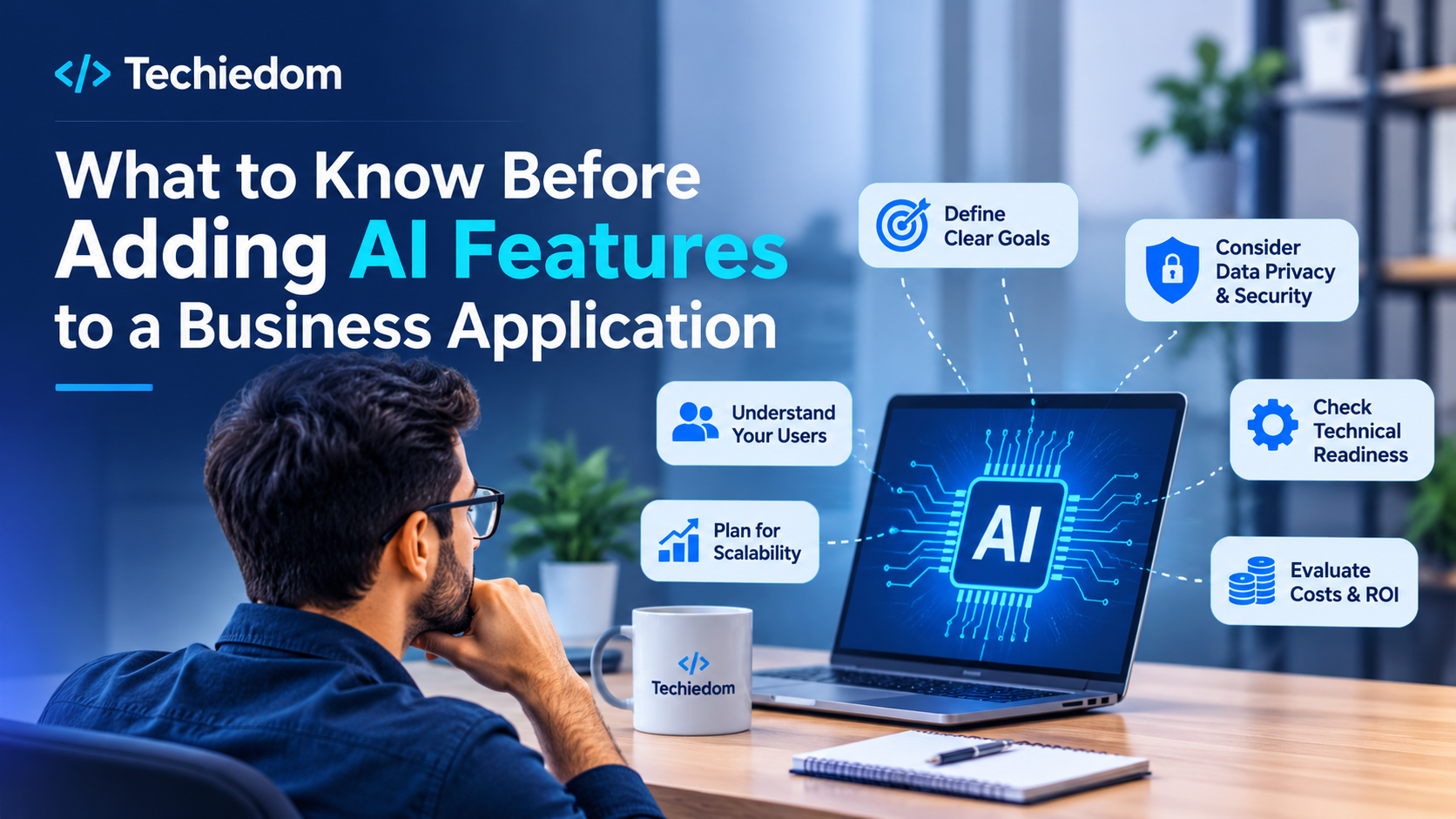
Artificial Intelligence (AI) is changing how businesses operate, manage information, interact with customers, and make decisions. From automated customer support to predictive analytics, AI-powered features are becoming an important part of modern business applications.
Many organizations are exploring ways to integrate AI into their existing software to improve productivity, reduce repetitive work, and deliver better customer experiences.
However, adding AI features to a business application involves more than connecting an AI API or implementing a chatbot. Businesses need to consider their objectives, data quality, security requirements, integration challenges, development costs, and long-term maintenance.
Before investing in AI-powered application development, it is important to understand what the technology can realistically achieve and how it can support your business operations.
In this guide, we will explore the key factors businesses should consider before adding AI features to their applications.
Before implementing AI, start by identifying a specific business problem.
Many businesses adopt AI simply because it is a growing technology trend. However, introducing AI without a clear purpose can increase development costs without delivering meaningful results.
Instead, identify processes where AI can provide measurable improvements.
For example:
The objective should be to solve an existing operational challenge rather than adding AI features that provide little practical value.
AI offers several capabilities that can be integrated into business applications. The right features depend on your industry, application functionality, and business requirements.
Here are some commonly used AI features.
AI chatbots can interact with customers, answer frequently asked questions, provide product information, and assist with basic support requests.
They can help businesses improve response times and reduce the workload on customer support teams.
Predictive analytics uses historical data and statistical or machine learning models to identify patterns and estimate future outcomes.
Businesses can use it for sales forecasting, customer behavior analysis, inventory planning, and demand prediction.
AI-powered document processing can extract information from invoices, contracts, applications, and other business documents.
This reduces the need for manual data entry and helps streamline administrative workflows.
Recommendation systems analyze customer preferences, behavior, and previous interactions to suggest relevant products, services, or content.
These features are particularly useful for eCommerce platforms, learning applications, and subscription-based businesses.
Traditional search functionality often depends on exact keywords.
AI-powered semantic search can understand the meaning and context behind user queries, helping users find more relevant information.
Generative AI can assist with creating product descriptions, email drafts, summaries, reports, and other business content.
Human review should remain part of workflows involving important or customer-facing information.
Data is one of the most important components of AI-powered applications.
AI systems rely on data to identify patterns, generate responses, make predictions, and support automated decisions.
However, poor-quality data can reduce the accuracy and usefulness of AI features.
Before implementation, evaluate whether your business data is:
For example, a business planning to introduce AI-powered lead scoring needs reliable historical information about customer inquiries, sales activities, and conversions.
If the available data is incomplete or inconsistent, the resulting predictions may be unreliable.
Cleaning and organizing existing data should therefore be an important part of AI implementation planning.
Not every AI model is suitable for every business application.
Some applications require conversational AI, while others need image recognition, predictive analytics, recommendation engines, or document processing.
The technology should be selected according to the intended functionality.
Common AI technologies and tools include:
| Technology | Business Application |
|---|---|
| OpenAI API | Conversational AI and content generation |
| Google Gemini API | AI-powered assistance and multimodal processing |
| Anthropic Claude API | Text analysis and AI assistance |
| TensorFlow | Machine learning model development |
| PyTorch | Deep learning applications |
| Hugging Face | Pre-trained models and NLP |
| LangChain | Building applications using language models |
| Vector Databases | Semantic search and retrieval systems |
For example, a business application that needs an AI-powered knowledge assistant may use a large language model with retrieval-augmented generation (RAG).
RAG allows an AI system to retrieve relevant information from approved business documents or databases before generating a response.
Selecting the right technology helps ensure that the AI functionality aligns with application requirements and available resources.
Security becomes particularly important when AI features interact with customer information, employee records, financial data, or internal business documents.
Businesses must understand how information is collected, processed, stored, and shared with AI providers.
Important security considerations include:
Businesses should also review the data handling and privacy policies of third-party AI providers before integrating their services.
For applications handling sensitive information, additional security controls and legal reviews may be necessary.
AI functionality should strengthen business operations without introducing unnecessary data privacy risks.
Adding AI features to an existing application requires careful integration planning.
The AI functionality should work smoothly with the application’s current frontend, backend, database, and business workflows.
For example, consider a CRM application that needs an AI-powered feature to summarize customer interactions.
The integration may involve:
Depending on the application architecture, developers may use APIs, backend services, webhooks, or background processing to connect AI functionality.
The integration should also consider API response times, rate limits, error handling, and service availability.
AI integration can introduce additional expenses beyond regular application development.
The total investment depends on the complexity of the feature, selected technology, data requirements, infrastructure, and expected usage.
Common cost components include:
For example, an AI chatbot using a third-party API may have different cost requirements compared with a custom machine learning system trained on business-specific datasets.
Businesses should also consider usage-based costs. As the number of users and AI requests increases, API consumption and infrastructure expenses may grow.
Planning a realistic budget before development helps prevent unexpected operational costs.
AI-generated results are not always accurate.
Generative AI models can sometimes produce incorrect information, misunderstand questions, or generate responses that sound convincing but are factually wrong.
This is particularly important when AI is used for customer support, financial reporting, document processing, and business decision-making.
Businesses should implement appropriate safeguards, such as:
For example, an AI-powered customer support assistant can answer routine questions but should transfer complex billing disputes or sensitive requests to a human representative.
AI should support employees and business processes rather than replace necessary human judgment.
AI features should make applications easier to use, not more complicated.
A poorly designed AI interface can confuse users and reduce adoption, even when the underlying technology performs well.
Consider how users will interact with AI functionality.
Important UI/UX considerations include:
For example, an AI writing assistant should allow users to review, edit, regenerate, or copy generated content without navigating through complicated menus.
The best AI features integrate naturally into existing workflows.
Implementing multiple AI features simultaneously can increase project complexity, development time, and financial risk.
A more practical approach is to begin with one clearly defined AI functionality.
A Minimum Viable Product (MVP) allows businesses to test whether the feature provides actual value before expanding the implementation.
For example, a CRM platform could initially introduce AI-powered lead summaries.
After evaluating user feedback, accuracy, and operational benefits, the business could consider additional capabilities such as lead scoring, predictive sales forecasting, and automated follow-ups.
This gradual approach helps businesses:
AI integration should be designed with future business requirements in mind.
As application usage increases, AI requests, data processing requirements, and infrastructure demands may also grow.
Developers should consider:
AI models and third-party services also evolve over time. Businesses should have a maintenance plan to review performance, update integrations, and address changing requirements.
A scalable architecture makes it easier to introduce new AI capabilities without rebuilding the entire application.
Even a well-funded AI project can fail if important implementation considerations are overlooked.
Here are some common mistakes businesses should avoid:
1. Implementing AI Without a Clear Objective
Adding AI simply to follow technology trends can result in unnecessary expenses. Every feature should solve a defined business problem.
2. Ignoring Data Quality
Poor-quality or incomplete data can negatively affect AI-generated results and predictions.
3. Depending Entirely on AI Outputs
AI-generated information should be reviewed whenever accuracy is important, especially in sensitive business operations.
4. Overlooking Integration Requirements
AI functionality should work properly with existing applications, databases, and business workflows.
5. Ignoring Usage-Based Costs
AI API charges can increase as application usage grows. Estimate ongoing expenses before launching the feature.
6. Neglecting Privacy and Security
Businesses should understand how customer and internal data is handled by AI services and implement suitable security controls.
7. Launching Too Many Features at Once
Starting with a focused AI MVP helps reduce risk and makes it easier to evaluate actual business value.
Businesses generally have two approaches when introducing AI into their applications: integrating existing AI services or developing custom AI solutions.
The right approach depends on the application’s requirements, available data, budget, and desired level of control.
| Comparison | Third-Party AI Integration | Custom AI Development |
|---|---|---|
| Implementation | Often faster | Usually more development-intensive |
| Initial Cost | Generally lower | Can be higher |
| Customization | Depends on provider capabilities | Greater control over model behavior |
| Maintenance | Depends partly on the provider | Requires ongoing technical management |
| Infrastructure | Often managed by the provider | Depends on deployment architecture |
| Use Cases | Chatbots, summaries, content generation | Specialized prediction and business-specific models |
| Scalability | Subject to provider limits and pricing | Can be designed around specific requirements |
For many businesses, integrating an existing AI API is a practical starting point.
However, applications with specialized data processing or unique machine learning requirements may benefit from custom AI development.
Adding AI features to a business application can create opportunities to automate workflows, improve customer experiences, and make better use of business data.
However, successful AI integration requires more than selecting a model or connecting an API. Businesses must understand their objectives, evaluate data quality, consider security requirements, plan integration, and account for ongoing costs.
Starting with a focused AI feature and expanding based on real-world results is often a practical way to introduce AI without unnecessary complexity.
By choosing the right technology and development approach, businesses can build intelligent applications that support their current operations while preparing for future growth.
Planning to integrate AI into your business application? TechieDom can help you explore custom software development, API integrations, and AI-powered solutions aligned with your business requirements.