
Customer relationships play a major role in business growth. Whether a company manages sales leads, customer support requests, marketing campaigns, or long-term client relationships, having the right Customer Relationship Management (CRM) system can make daily operations more efficient.
However, businesses often face an important decision: should they invest in custom CRM development or choose ready-made CRM software?
Both options help organizations manage customer information, track interactions, automate tasks, and improve sales processes. The main difference lies in how the software is designed, how much flexibility it offers, and how well it fits a company’s specific requirements.
In this guide, we compare custom CRM development vs ready-made CRM software to help you determine which solution is the right fit for your business.
Custom CRM development involves building a customer relationship management system specifically for a business. Instead of adapting existing software to fit your processes, developers create a solution based on your company’s workflows, goals, and operational requirements.
A custom CRM can include features such as lead management, sales pipeline tracking, customer communication history, automated follow-ups, reporting dashboards, and integrations with existing business tools.
Businesses with specialized processes or complex requirements often consider custom CRM development because it gives them greater control over the system’s functionality and future development.
Custom CRM development can be particularly useful for growing companies that have outgrown generic tools or need a CRM that supports a unique business model.
Ready-made CRM software is a prebuilt solution developed for businesses to use with minimal setup. These platforms generally provide standard features for managing contacts, tracking sales opportunities, automating tasks, and monitoring customer interactions.
Many ready-made CRM solutions offer subscription-based pricing, cloud hosting, predefined workflows, and integrations with commonly used business applications.
Because the core system is already developed, businesses can typically start using it much faster than a fully custom-built platform.
Ready-made CRM software is often a practical choice for startups, small businesses, and organizations whose needs align with standard CRM functionality.
Understanding the differences between these approaches can help you evaluate which solution offers the most value for your organization.
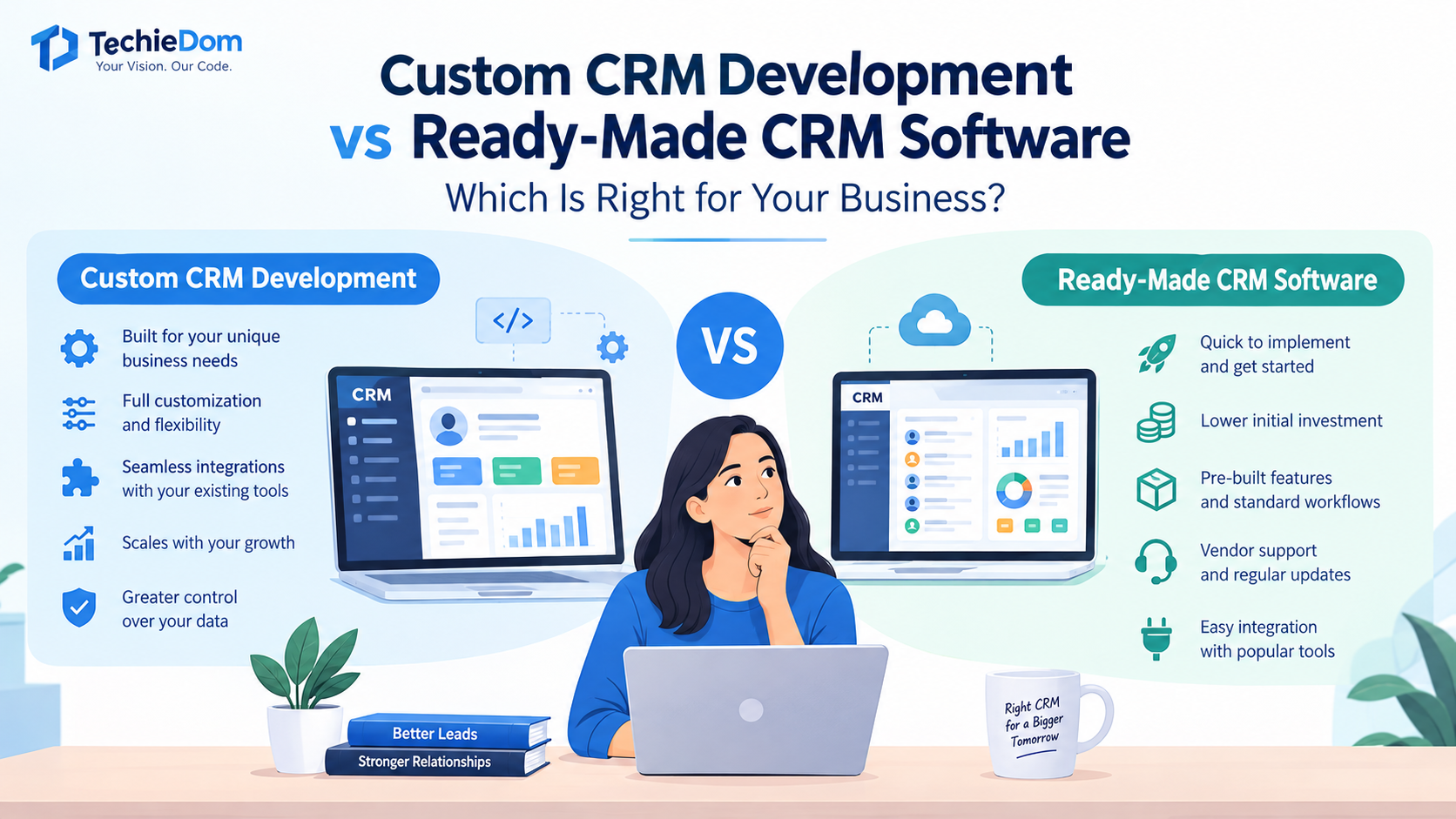
| Comparison Factor | Custom CRM Development | Ready-Made CRM Software |
|---|---|---|
| Initial cost | Generally higher | Generally lower |
| Implementation time | Requires planning and development | Usually faster to deploy |
| Customization | Extensive control over functionality | Limited to available settings and supported extensions |
| Scalability | Can be designed around future requirements | Depends on the platform and subscription plan |
| Maintenance | Requires an internal team or development partner | Typically managed partly by the software vendor |
| Integrations | Can be developed for specific systems | Depends on available integrations and APIs |
| Data control | Greater control over architecture and hosting choices | Depends on the vendor’s policies and hosting options |
| Ownership | Depends on the development contract and licensing terms | Usually governed by the vendor’s licensing agreement |
| Best suited for | Businesses with specialized workflows | Businesses with standard CRM requirements |
Neither option is automatically better. The right choice depends on your business processes, budget, technical resources, and long-term plans.
Cost is often one of the first factors businesses consider when choosing CRM software.
Ready-made CRM platforms usually require a subscription, which may be charged per user or according to the features included in a plan. This makes initial adoption more affordable, although recurring fees can increase as the number of users or required features grows.
Custom CRM development generally requires a larger upfront investment. Expenses may include business analysis, UI/UX design, software development, testing, deployment, integrations, and ongoing maintenance.
However, a custom solution may provide better long-term value if it eliminates expensive workarounds, reduces manual tasks, or replaces several disconnected applications.
What should you choose?
Choose ready-made CRM software if you need essential functionality at a lower initial cost. Consider custom CRM development if your specific requirements justify the investment over time.
Every business manages customer relationships differently. A real estate company may need property inquiry tracking, while a B2B technology company may require complex lead qualification, account management, and multi-stage sales workflows.
Ready-made CRM platforms offer configuration options, but some advanced requirements may need paid add-ons, third-party applications, or workarounds.
Custom CRM development allows businesses to define the features, workflows, dashboards, and automation rules that best support their operations.
For example, a company could build automated lead assignment based on location, industry, deal value, or sales representative availability.
If your business relies on specialized workflows, customization can make a meaningful difference in productivity.
The time required to launch a CRM system varies depending on its complexity and the level of customization needed.
Ready-made CRM software is usually quicker to implement because the platform already exists. Businesses can configure user accounts, import customer data, connect supported applications, and train employees before launching.
Custom CRM development requires a more detailed process. It typically involves requirement gathering, planning, design, development, testing, deployment, and user training.
A simpler custom CRM may be launched relatively quickly, while a complex platform with multiple integrations can require considerably more time.
Businesses with immediate CRM needs may benefit from a ready-made solution, while organizations with specialized long-term requirements may prefer a phased custom development approach.
Your CRM should support your business as it grows. An increase in customers, employees, sales activities, and reporting requirements can place additional demands on your software.
Ready-made CRM platforms may provide higher subscription tiers, additional modules, and upgraded usage limits. However, businesses may encounter restrictions related to workflows, data models, integrations, or pricing.
Custom CRM development allows the system to be designed around anticipated growth. Developers can plan for additional user roles, new business units, advanced reporting, and more complex workflows.
Scalability still depends on good software architecture, infrastructure, testing, and ongoing maintenance. Custom development alone does not guarantee better performance.
Before making a decision, consider your expected business growth and the limitations of each platform.
Businesses often use several applications to manage different operations, including email marketing, accounting, customer support, project management, and enterprise resource planning.
A ready-made CRM may integrate with popular applications through built-in connectors or third-party services. These integrations can reduce setup time, but availability and functionality depend on the selected platform and subscription.
Custom CRM development provides greater flexibility when integrating with proprietary systems, internal databases, or specialized applications. Developers can build APIs and data synchronization processes to connect the CRM with existing business infrastructure.
If your company depends on several specialized systems, evaluate integration requirements before choosing either approach.
Customer data can include contact information, communication records, purchase history, and other business-sensitive information. Protecting this data should be a priority when selecting a CRM.
Established CRM vendors may offer security controls such as role-based access, encryption, authentication features, audit logs, and regular platform updates. The exact protections vary by provider and plan.
A custom CRM can be designed with specific security requirements, including granular permissions, custom audit trails, and deployment options suited to the organization’s needs.
However, custom development also creates ongoing security responsibilities. The business must ensure that the application is properly tested, updated, monitored, and maintained.
When comparing options, review access controls, backup procedures, data retention policies, compliance requirements, and incident response processes.
CRM software requires ongoing maintenance to remain reliable, secure, and compatible with changing business needs.
With ready-made CRM software, the vendor generally manages core platform updates, infrastructure, and product improvements. Businesses may still need to manage configurations, integrations, data quality, and user access.
A custom CRM requires a development team or technology partner to maintain the application, fix bugs, monitor performance, update dependencies, and implement new features.
The level of support you need will depend on your internal technical expertise and the complexity of your system.
For companies without an in-house development team, the availability of reliable technical support should be part of the overall cost calculation.
Custom CRM development may be the better option when your business has requirements that standard platforms cannot handle efficiently.
Consider a custom solution if:
For example, a logistics company managing customer inquiries, shipment updates, service requests, and account-specific workflows may benefit from a CRM designed around its operational processes.
The key is to identify a measurable business need rather than building custom software simply for the sake of customization.
Ready-made CRM software is often the most practical option when a business needs standard customer management features without a lengthy development process.
Consider an existing CRM platform if:
For example, a small consulting agency may need contact management, email tracking, follow-up reminders, and a simple sales pipeline. A ready-made CRM could provide these capabilities without requiring a separate development project.
Yes. Businesses do not always need to choose between a completely custom CRM and a fully standard platform.
A hybrid approach can provide a practical middle ground.
For example, a company could use a ready-made CRM for contact management and sales tracking while developing custom integrations, reporting dashboards, or workflow automation around it.
Another option is to begin with a ready-made platform and transition to a custom CRM when the business develops more complex requirements.
This approach can reduce initial risk and help businesses make decisions based on actual usage, operational challenges, and measurable results.
Before choosing a hybrid model, check whether the existing CRM supports the necessary APIs, data access, customization, and integration capabilities.
Before investing in CRM software, evaluate your current requirements and future objectives.
List the problems you want the CRM to solve. These might include missed follow-ups, scattered customer data, inefficient sales reporting, or manual data entry.
Separate essential features from optional improvements.
Consider the total cost of ownership rather than the initial price alone. Include subscriptions, implementation, training, integrations, maintenance, and future upgrades.
Determine whether your processes fit standard CRM functionality or require significant customization.
Identify the applications and databases the CRM must connect with. Confirm whether the required integrations are available and reliable.
Estimate how your needs may change as your customer base, team, and operational complexity increase.
Review relevant experience, technical capabilities, support arrangements, security practices, and project delivery processes.
Use a trial, pilot project, prototype, or proof of concept to validate the solution before making a major investment.
A structured evaluation helps reduce unnecessary spending and improves the likelihood of selecting a CRM that supports your business objectives.
Selecting the right CRM strategy involves more than choosing a list of features. Businesses must also consider usability, integrations, data security, scalability, and long-term maintenance.
A professional software development company can help assess your existing workflows, identify technical requirements, and determine whether custom development, ready-made software, or a hybrid solution is most appropriate.
The development process may include business analysis, UI/UX design, application architecture, CRM development, API integrations, testing, deployment, and ongoing support.
At TechieDom, businesses can explore software development solutions aligned with their operational goals and digital growth plans. A well-planned CRM project should focus on solving real business challenges, improving team productivity, and creating a better customer management process.
Choosing between custom CRM development vs ready-made CRM software depends on your organization’s needs, budget, operational complexity, and long-term goals.
Ready-made CRM software is often ideal for businesses that need standard features, faster implementation, and a lower initial investment. Custom CRM development is worth considering when specialized workflows, integrations, or greater control over functionality are important to business success.
For some organizations, a hybrid approach offers the best balance between speed, flexibility, and cost.
The most effective CRM is not necessarily the one with the most features. It is the one that helps your team manage customer relationships efficiently, make better decisions, and support sustainable business growth.
Need a CRM solution tailored to your business? Explore software development services from TechieDom to discuss an approach that aligns with your workflows, technical requirements, and growth objectives.
Custom CRM development is better for businesses with specialized workflows and unique integration requirements. Ready-made CRM software is often more suitable for businesses that need standard features and faster implementation.
Custom CRM development generally involves higher upfront costs because it requires planning, design, development, and testing. However, its long-term value depends on maintenance expenses, business efficiency, and the cost of alternatives.
The timeline depends on the complexity of the system, required features, integrations, and testing needs. A basic CRM may take weeks to months, while a complex enterprise solution can take longer.
Yes. Many ready-made CRM platforms support configurable workflows, custom fields, dashboards, automation, and third-party integrations. Advanced customization depends on the platform and subscription plan.
Yes, particularly when its workflows are specialized or existing platforms create significant inefficiencies. However, a small business should compare the development and maintenance costs with the benefits before investing.
A growing business should evaluate its current needs, expected growth, budget, and technical requirements. Ready-made software may be sufficient initially, while custom development or a hybrid approach may become valuable as requirements evolve.