
Starting a new business often comes with financial challenges. You may have an innovative product idea, a clear vision, and a target audience, but limited resources can make it difficult to turn that idea into a working product.
This is where a Minimum Viable Product (MVP) becomes valuable.
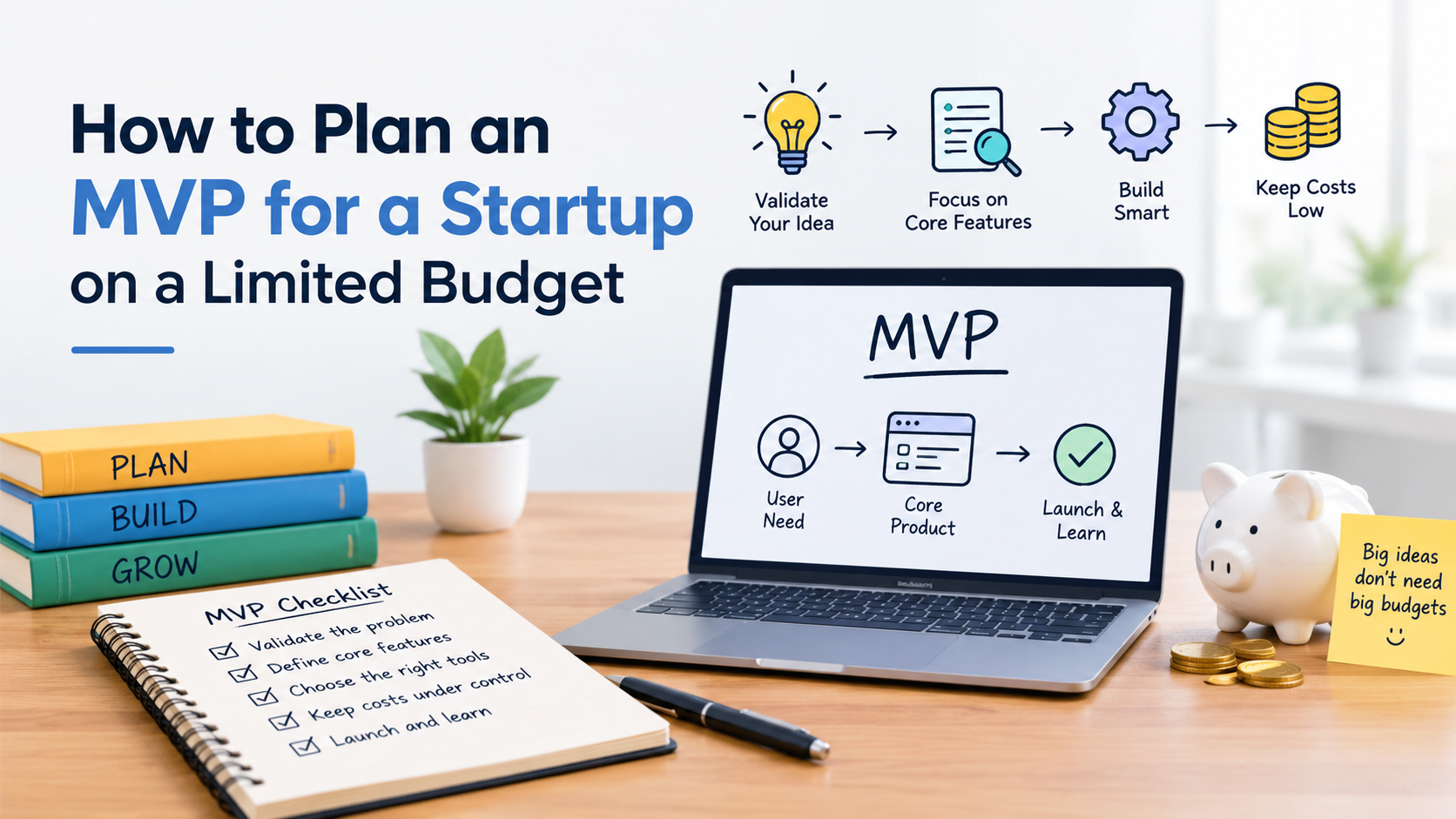
An MVP allows startups to launch a simplified version of their product with only the essential features needed to solve a specific problem and collect feedback from early users. Instead of investing heavily in a complete product from the beginning, founders can test their assumptions, understand customer needs, and make informed decisions about future development.
However, building an MVP on a limited budget requires careful planning. Choosing the wrong features, investing in unnecessary technology, or skipping customer research can increase costs without improving the product’s chances of success.
In this guide, we will explain how to plan an MVP for a startup on a limited budget, prioritize essential features, select the right technology, manage development costs, and validate your idea before investing in a larger product.
A Minimum Viable Product is an early version of a product that includes enough functionality to deliver its core value to a target audience and help a startup learn from real-world usage.
The objective is not to build an incomplete or low-quality product. Instead, it is to focus development efforts on the smallest practical solution that can test your most important business assumptions.
For example, imagine you want to build a food delivery application.
A fully developed platform might include real-time tracking, loyalty programs, restaurant analytics, personalized recommendations, and multiple payment options.
An MVP could begin with essential features such as:
These features may be sufficient to test whether customers want to use your platform and whether restaurants are willing to participate.
Based on the feedback and results, you can decide which additional features deserve investment.
For early-stage businesses, spending too much on product development before validating demand can create unnecessary financial pressure.
An MVP offers a more controlled approach by allowing founders to test ideas before committing to a larger investment.
Building only the essential features reduces the amount of design, development, and testing required for the initial release.
This allows startups to use their available funds more strategically instead of paying for features that may never be used.
A product idea may sound promising, but customer behavior provides more reliable evidence of its potential.
An MVP allows you to observe whether users understand your solution, find it useful, and are willing to adopt or pay for it.
Real users can reveal problems and opportunities that may not become apparent during planning.
Their feedback helps you improve the product based on actual needs rather than assumptions.
Early validation provides useful information for deciding whether to improve the product, change its direction, expand its features, or reconsider the business model.
Without a clear scope, startups can spend months building complex features before discovering that customers primarily need a much simpler solution.
An MVP helps keep development focused on the problem that matters most.
Before choosing technologies or hiring developers, clearly identify the problem your product will address.
A successful MVP starts with a specific customer need rather than a long list of features.
Ask yourself:
For example, suppose you want to build a project management tool for small marketing agencies.
Rather than creating a platform with dozens of collaboration features, you might discover that your target customers primarily struggle with assigning tasks and tracking deadlines.
Your MVP could focus on task creation, team assignments, deadline management, and a simple progress dashboard.
Practical tip: Write a one-sentence value proposition explaining who your product serves, what problem it solves, and why it matters.
This statement will guide your feature decisions throughout development.
Customer research does not need to be expensive. Startups can gather useful insights through conversations, online surveys, competitor reviews, and discussions in relevant communities.
The goal is to understand whether your proposed solution addresses a meaningful problem.
Consider the following research activities:
Competitor research can help you identify gaps in existing products. However, avoid copying every feature offered by established competitors. Their products may serve broader audiences or operate with significantly larger budgets.
Focus on the needs of your initial target audience and identify the smallest solution that can provide meaningful value.
Feature prioritization is one of the most important steps when planning an MVP on a limited budget.
Every additional feature can increase development time, testing requirements, maintenance responsibilities, and project complexity.
Start by dividing potential features into three categories.
| Priority | Description | Example: Appointment Booking App |
|---|---|---|
| Must-have | Required to deliver the core value | Browse services, select a time, book an appointment |
| Should-have | Useful but not essential for the first release | Appointment reminders |
| Could-have | Can be considered after validation | Loyalty rewards, advanced analytics, personalized recommendations |
For the initial release, focus primarily on must-have features.
You can also use the MoSCoW prioritization method, which categorizes requirements as Must have, Should have, Could have, and Won’t have for the current release.
The key is to establish a clear boundary between what is necessary to test your idea and what can wait until later.
Avoid treating every stakeholder request as essential. Each feature should have a clear connection to the problem your MVP is designed to solve.
Before starting development, determine how much money your startup can reasonably invest without putting essential business operations at risk.
Your budget should cover more than coding. Product discovery, design, testing, deployment, and early maintenance can all require resources.
Consider these potential cost categories:
A useful budgeting approach is to separate your available funds into initial development, launch expenses, and post-launch improvements.
For example, if your startup has a total initial budget of $5,000, do not automatically allocate the entire amount to development. Reserve some funds for essential tools, deployment, and improvements based on user feedback.
The exact allocation will depend on product complexity, team structure, and technical requirements.
Ask potential development partners for a detailed estimate based on a clearly defined scope. A realistic proposal should explain assumptions, deliverables, exclusions, and possible additional costs.
Selecting the right technology can influence your initial development costs, future maintenance requirements, performance, and ability to scale.
However, the most expensive or newest technology is not automatically the best choice for a startup.
Choose a technology stack based on your product’s actual requirements, your team’s expertise, and the expected development timeline.
Custom web or mobile development can be suitable when your product requires specialized functionality, complex workflows, or integrations that existing tools cannot support.
Technologies such as React, Laravel, Node.js, and other established frameworks may be appropriate depending on the project’s architecture and requirements.
No-code and low-code platforms can help founders test relatively straightforward ideas without building every component from scratch.
They may work well for prototypes, internal tools, simple marketplaces, and workflow-based applications.
However, check platform limitations, subscription fees, integration options, data portability, and customization requirements before committing.
You may be able to reduce development effort by using established services for authentication, payments, email notifications, analytics, or customer support.
Using managed services can save time, but consider recurring fees, usage limits, security responsibilities, and vendor dependency.
The best approach: Choose the simplest reliable technology that can validate your idea while supporting a practical path for future development.
Designing screens directly in code can lead to expensive changes when stakeholders discover usability issues or missing functionality.
Wireframes help you plan the structure of your product before development begins.
They show where key elements will appear, how users will navigate between screens, and what actions they can take.
For a basic SaaS MVP, wireframes might cover:
You do not necessarily need an elaborate design system or dozens of polished screens at this stage.
Start with the primary user journey and create a clickable prototype when it will help stakeholders or potential customers understand the concept.
Testing a prototype with a few representative users can reveal confusing navigation and missing steps before development resources are committed.
A clear design foundation also helps developers estimate work more accurately.
Your MVP should make it easy for users to experience its main benefit.
Identify the shortest practical journey that takes someone from discovering the product to completing its primary task.
For example, a subscription-based learning platform might follow this journey:
Focus on making these steps reliable before adding secondary functionality.
Avoid building complex dashboards, advanced reporting, extensive personalization, or elaborate administrative tools unless they are necessary for the initial validation.
At the same time, do not compromise on essential quality. The product must be usable, reasonably secure, and reliable enough to support the intended users.
An MVP should be limited in scope, not careless in execution.
If your startup does not have an in-house technical team, working with an experienced web or software development company can help you turn your idea into a functional product.
However, the right partner should understand early-stage business constraints rather than simply recommend a large development project.
Look for a team that can:
Ask prospective partners to provide examples of relevant projects, a proposed MVP scope, a development timeline, and a breakdown of expected costs.
Also clarify who owns the source code, design files, and other project assets.
For a startup with limited funding, a phased engagement can be useful. You might begin with product discovery and wireframes, then proceed to development once the scope and feasibility are clearer.
A phased development approach helps startups manage uncertainty and review progress before committing to the next stage.
Instead of waiting until the entire product is complete, divide the work into manageable milestones.
A typical process may include:
Phase 1: Discovery and planning
Define the problem, target users, requirements, essential features, and success criteria.
Phase 2: UI/UX design
Create wireframes, user flows, and prototypes for the primary user journey.
Phase 3: MVP development
Build the essential frontend, backend, database structure, and integrations.
Phase 4: Testing and launch preparation
Test core functionality, address critical bugs, review security, and prepare deployment.
Phase 5: Initial launch and learning
Release the product to a suitable group of early users, collect feedback, and identify improvements.
Use milestones to review deliverables, manage scope, and catch issues early.
An iterative process does not automatically guarantee lower costs, but it can help teams identify problems sooner and avoid investing heavily in features that are not yet validated.
Launching quickly is useful only if your product works well enough for users to evaluate its value.
Before releasing the MVP, test the primary user journeys and resolve critical issues.
Your initial testing should cover:
Invite a small group of target users to try the product before making it widely available.
Observe where they struggle, which features they use, and whether they can complete the intended task without assistance.
Early testing can reveal usability problems that internal teams may overlook because they already understand how the product is supposed to work.
An MVP is a learning tool, so success should be measured against the assumptions you wanted to validate.
Before launch, decide which metrics matter for your business model.
| Metric | What It Helps You Understand |
|---|---|
| Sign-up conversion rate | Whether visitors are interested enough to register |
| Activation rate | Whether new users reach the product’s core value |
| User retention | Whether users return after their first experience |
| Task completion rate | Whether users can complete the primary action |
| Customer feedback | What users value and where they experience problems |
| Paid conversion rate | Whether users are willing to pay, when monetization is relevant |
Do not measure success solely by the number of features delivered or downloads received.
For example, a project management MVP with a small number of engaged business customers may provide more useful validation than a product with many registrations but little ongoing use.
Use the evidence to decide what to do next. You may need to improve onboarding, simplify the user experience, add a missing capability, change your target audience, or reconsider the underlying business idea.
The goal is to make the next investment more informed than the last.
Even with a limited scope, startups can waste resources if they approach product development without a clear strategy.
Avoid these common mistakes:
Building too many features: Every extra feature adds complexity. Prioritize the functionality required to test your core assumption.
Skipping customer research: Developing without understanding the target audience can result in a product nobody needs.
Choosing technology based only on price: A cheap initial setup may create higher maintenance costs or limit future development.
Ignoring UI/UX design: Confusing navigation can prevent users from experiencing the product’s intended value.
Underestimating testing: Critical bugs and unreliable integrations can undermine user trust.
Failing to define project scope: Uncontrolled changes can increase costs and delay launch.
Spending the entire budget before launch: Keep resources available for feedback-driven improvements and unexpected needs.
Expecting immediate product-market fit: An MVP provides evidence, not a guarantee of commercial success.
Avoiding these mistakes helps your startup focus its resources on learning, delivering value, and making better product decisions.
Turning an idea into a working product requires more than development alone. Startups also need clear requirements, thoughtful design, suitable technology, and a practical plan for future improvements.
TechieDom offers technology-related services that businesses can explore when planning website development, custom software solutions, and other digital projects.
For founders working with a limited budget, the first step is to identify the core problem, define the essential features, and establish a realistic development scope.
A well-structured MVP project can then focus on delivering the primary user journey, testing the product with early adopters, and using feedback to guide future investment.
When discussing your startup idea with a development partner, be prepared to explain your target audience, business objectives, required functionality, budget constraints, and expected timeline.
This information helps the team assess your requirements and determine an appropriate development approach.
Explore TechieDom’s services to discuss your product idea and identify the next steps toward building your MVP.
Planning an MVP for a startup on a limited budget is about making informed decisions, not simply spending less on development.
Start by identifying a genuine customer problem, researching your target market, and prioritizing the features that deliver your product’s core value. Set a realistic budget, choose suitable technology, and work through clear development milestones.
Once your MVP is ready, test it with real users, measure meaningful results, and use their feedback to guide future improvements.
You do not need to build every feature to begin learning from the market. A focused, well-planned MVP can help your startup validate assumptions, reduce unnecessary development, and make more confident decisions about its next stage of growth.
Ready to turn your startup idea into a working product? Explore TechieDom’s development services and start planning an MVP that aligns with your business goals and available resources.