

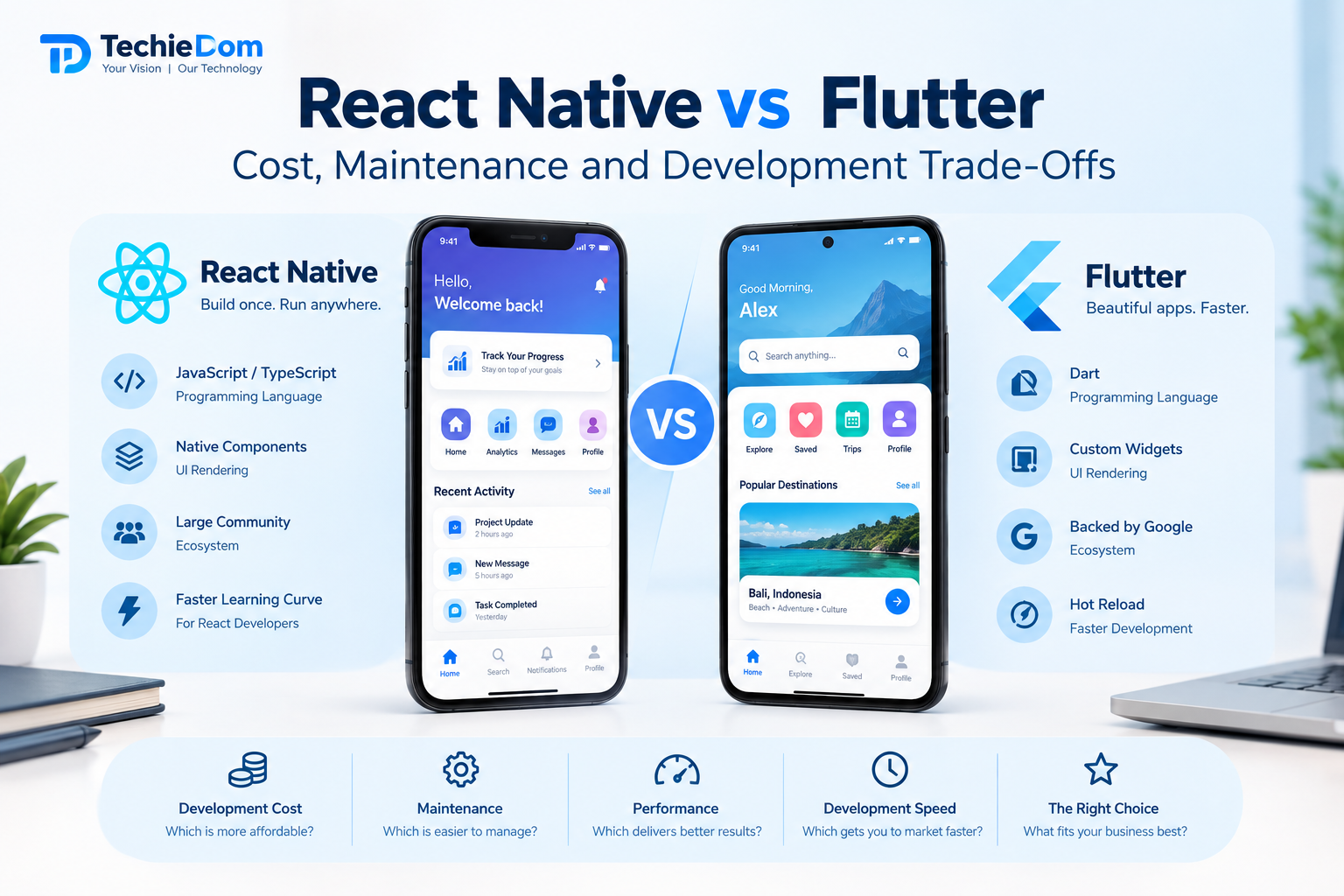
Choosing the right technology is one of the most important decisions when building a mobile application. The framework you select can influence development timelines, project costs, user experience, maintenance requirements, and your ability to introduce new features in the future.
For businesses planning to launch an iOS and Android application, two popular cross-platform development frameworks are React Native and Flutter.
Both frameworks allow developers to build applications for multiple platforms using a shared codebase, reducing the need to develop two completely separate applications. However, they differ in programming languages, user interface rendering, ecosystem, and development workflows.
So, which one offers better value for your business?
The answer depends on your application requirements, existing technology infrastructure, development team’s expertise, and long-term product roadmap.
In this guide, we compare React Native vs Flutter across development cost, maintenance, performance, scalability, and other important business considerations to help you make an informed decision.
React Native is an open-source framework backed by Meta that allows developers to build mobile applications using JavaScript or TypeScript and React concepts.
It enables developers to reuse much of their application logic across iOS and Android while rendering interface elements through native platform components.
React Native is particularly attractive to businesses that already use React for web development because some development skills, business logic, and compatible code patterns may be shared between web and mobile projects.
React Native can be a strong choice for businesses that already have React developers, need to launch on multiple mobile platforms, or want to share compatible logic with an existing web application.
For example, a SaaS company with a React-based dashboard may choose React Native for its mobile application because its existing team can reuse relevant knowledge and selected business logic.
However, shared skills do not mean the entire web application can automatically be reused as a mobile app. Platform-specific interfaces, integrations, and testing are still required.
Flutter is an open-source UI framework developed by Google. It uses Dart as its programming language and enables developers to build applications for iOS, Android, web, desktop, and other supported platforms from a shared codebase.
Unlike React Native, Flutter primarily renders its interface using its own widget system and rendering engine. This gives developers considerable control over visual design and consistency across supported platforms.
Flutter is particularly useful for applications that require custom interfaces, branded design systems, animations, or a consistent appearance across multiple devices.
Flutter can be a suitable choice for businesses that need a highly customized user interface or want to build mobile applications with a consistent visual identity.
For example, a fintech startup may need custom dashboards, interactive charts, branded components, and carefully controlled layouts across Android and iOS.
Flutter can also be worth evaluating when a business plans to expand its product to supported web or desktop platforms, although the suitability of those targets depends on the application’s functionality and user experience requirements.
The two frameworks can both support production applications, but their technical approaches and development ecosystems differ.
| Comparison Factor | React Native | Flutter |
|---|---|---|
| Developer | Meta | |
| Programming language | JavaScript or TypeScript | Dart |
| UI approach | Uses native platform components through its rendering architecture | Primarily renders its own widget-based interface |
| Code reuse | Shares compatible logic across platforms | Shares application code across supported platforms |
| Existing team advantage | Strong fit for React and JavaScript teams | Strong fit for teams experienced in Flutter and Dart |
| UI customization | Flexible, with platform-specific behavior where appropriate | Extensive control over custom interface rendering |
| Development tools | React Native tools and its surrounding ecosystem | Flutter SDK, DevTools, and integrated tooling |
| Maintenance focus | Dependencies, native modules, framework upgrades, and platform compatibility | Flutter SDK, packages, plugins, and platform compatibility |
| Performance | Strong when implemented and optimized correctly | Strong when implemented and optimized correctly |
| Best suited for | React-oriented teams and apps that benefit from native components | Custom UI experiences and consistent cross-platform design |
Neither framework automatically guarantees a cheaper, faster, or better-performing application. Project complexity and implementation quality matter considerably.
Development cost is often one of the first considerations for businesses planning a mobile application.
Both React Native and Flutter can reduce the effort required to build separate iOS and Android applications. However, the actual cost depends on the features, integrations, design requirements, team structure, and testing scope.
React Native may be cost-effective when a business already has developers experienced in JavaScript, TypeScript, or React.
The existing team may be able to reuse development knowledge, compatible libraries, and selected business logic from a web application.
Potential cost advantages include:
However, complex native integrations, platform-specific behavior, and incompatible third-party libraries can introduce additional work.
Flutter can also be cost-effective, particularly when the team is experienced in Dart and Flutter.
Its integrated tooling and shared widget system can simplify the implementation of consistent interfaces across platforms. A common design system can also reduce duplicated UI work.
Potential cost advantages include:
However, businesses without Flutter expertise may need additional onboarding or recruitment. Specialized plugins and platform-specific functionality can also increase implementation costs.
The framework is only one factor in the total project budget.
Consider the following cost drivers:
Business takeaway: React Native may provide a cost advantage for an existing React team, while Flutter may provide better value for projects that benefit from a shared, highly customized interface. Neither framework is universally cheaper.
Building an application is only the beginning. After launch, businesses need to maintain security, resolve bugs, support new operating system versions, update dependencies, and introduce new features.
The framework you select influences how this work is organized.
React Native applications often depend on a combination of the React Native framework, JavaScript packages, native modules, and platform-specific code.
Maintenance work may include:
Businesses with an established React and JavaScript team may find it easier to assign these responsibilities internally.
However, relying on outdated or poorly maintained packages can create technical debt and make future upgrades more difficult.
Flutter applications depend on the Flutter SDK, Dart packages, plugins, and any native integrations used by the project.
Maintenance work may include:
Flutter’s shared UI implementation can help reduce duplicated interface maintenance across platforms.
However, plugin availability and the quality of third-party dependencies still matter. Some functionality may require custom native code or additional platform-specific testing.
There is no universal winner.
React Native may be easier to maintain when the business already has a React-oriented team and a well-managed JavaScript codebase.
Flutter may be easier to maintain when the development team is experienced with Flutter and the application benefits from a unified widget system.
In both cases, maintainable architecture, automated testing, dependency management, documentation, and clear ownership can have a greater impact on long-term costs than the framework alone.
Performance affects user experience, engagement, and the perceived quality of an application.
Both React Native and Flutter can deliver strong performance for many business applications, including e-commerce platforms, SaaS products, booking systems, and customer portals.
Their implementation approaches differ, however.
React Native renders interface elements through native platform components and uses JavaScript or TypeScript for much of the application logic.
Its modern architecture supports more direct interaction between JavaScript and native components than the older bridge-based approach.
Performance depends on factors such as component rendering, state management, animations, network requests, and third-party libraries.
Applications with large lists, frequent updates, or computationally intensive tasks may require careful profiling and optimization.
Flutter uses its own widget framework and rendering engine to control the application’s interface.
This approach can be advantageous for custom graphics, animations, and interfaces that need a consistent appearance across platforms.
However, performance still depends on application architecture, rendering complexity, image optimization, memory usage, and the quality of the implementation.
Instead of relying on generic benchmark claims, test both frameworks against your actual requirements.
Evaluate:
Business takeaway: For typical business applications, either framework may perform well. A short technical prototype and testing on representative devices can reveal more than broad claims that one framework is always faster.
Launching an application quickly can help businesses validate an idea, collect user feedback, and respond to market opportunities.
React Native and Flutter both provide development workflows that support rapid iteration.
React Native can be especially efficient when developers already understand React and TypeScript.
Teams may benefit from familiar programming concepts, compatible tooling, and existing business logic.
If the company has an established React web application, selected utilities and validation logic may be reusable. However, web components and browser-specific code generally cannot be transferred directly to mobile interfaces.
Flutter supports rapid interface development through reusable widgets and hot reload.
Developers can modify layouts, styles, and application behavior and see many changes quickly without restarting the entire application.
Its unified UI approach can also simplify the process of building consistent screens for Android and iOS.
However, learning Dart, implementing integrations, and creating custom functionality still require appropriate development time.
The answer depends on the development team and the project scope.
React Native may be faster for a React-oriented team. Flutter may be faster for a team that already uses Flutter and needs a custom interface.
For a new team with no relevant experience, compare onboarding, recruitment, design complexity, integrations, and testing requirements before making a decision.
The user interface plays a significant role in how customers perceive a digital product.
A banking application, online marketplace, healthcare platform, and internal business tool may all require different interface priorities.
React Native allows developers to build interfaces using native platform components and custom components.
This can help applications feel familiar to users on iOS and Android, although platform-specific differences may require additional implementation and testing.
It is a good option when native interaction patterns and integration with existing React skills are important.
Flutter provides a rich widget system and extensive control over layouts, transitions, and custom visual components.
This can make it attractive for businesses that want a distinct brand identity or a highly consistent interface across devices.
The trade-off is that some platform conventions may need to be implemented deliberately rather than inherited from native components.
Flutter is worth considering when a project requires extensive custom rendering or a consistent branded interface.
React Native is worth considering when the application benefits from native platform components and the team’s existing React expertise.
The right choice should be guided by the design requirements and usability testing rather than visual flexibility alone.
A mobile application may start with a few essential features and eventually expand to support thousands of users, multiple integrations, and complex workflows.
Both frameworks can support scalable applications, provided the surrounding architecture is designed appropriately.
React Native can be a good fit for businesses that want to integrate mobile development into an existing React and JavaScript ecosystem.
Its flexibility allows teams to introduce new features, integrate APIs, and maintain shared development practices across compatible projects.
As the application grows, developers must manage dependencies, module boundaries, application state, testing, and platform-specific functionality carefully.
Flutter supports structured application development through reusable widgets and shared application logic.
Its architecture can help teams maintain consistent interfaces as the product expands.
However, scalability also depends on backend architecture, database design, API performance, security, and infrastructure. Choosing Flutter alone does not solve these challenges.
Both are capable of supporting long-term product development.
Consider your planned features, existing infrastructure, team capabilities, integration requirements, and likely hiring needs before selecting a framework.
A well-architected application with clear documentation will generally be easier to extend than one built quickly without a long-term maintenance plan.
Your ability to recruit developers and maintain the application over several years is an important business consideration.
React Native uses JavaScript or TypeScript, which may make recruitment easier for organizations already hiring React and web developers.
Flutter uses Dart, so businesses may need to recruit Flutter specialists or train developers who are new to the framework.
However, general language popularity does not guarantee that qualified mobile developers are available in your location or within your budget.
Before choosing, evaluate:
A framework that matches your team’s existing skills may offer a practical advantage throughout the application’s lifecycle.
Use the following decision guide to identify the framework that best fits your project.
| Business Requirement | Framework Worth Considering | Reason |
|---|---|---|
| Existing React or TypeScript team | React Native | Makes use of familiar skills |
| Existing React web application | React Native | May allow reuse of compatible logic |
| Highly customized visual interface | Flutter | Offers extensive UI rendering control |
| Consistent design across mobile platforms | Flutter | Shared widget system supports visual consistency |
| Application with standard business workflows | Either | Both can support common business features |
| Complex native device integration | Either, subject to evaluation | Depends on the required APIs and available libraries |
| Limited internal development expertise | Depends on the delivery partner | Team experience and handover quality are critical |
| Long-term maintenance by an existing team | Match the team’s expertise | Familiarity can reduce onboarding and support effort |
Neither framework should be selected solely because it is popular. A short technical assessment can help establish which option is more appropriate for your specific requirements.
Selecting a mobile development framework requires more than comparing programming languages or development tools. Businesses need to understand how the choice will affect the entire product lifecycle, from planning and design to deployment and ongoing support.
TechieDom can help businesses evaluate their mobile application requirements and identify an appropriate development approach based on project scope, user experience, integrations, and long-term objectives.
Depending on your needs, the development process may include:
The objective is to choose a technology that delivers value beyond launch day and remains practical to maintain as the business grows.
React Native and Flutter are both capable cross-platform development frameworks, but they offer different advantages.
React Native is often a strong option for businesses with existing React expertise, JavaScript-based infrastructure, or a need to share compatible logic with web applications.
Flutter is often worth considering for applications that require highly customized interfaces, consistent cross-platform rendering, and a unified widget-based development approach.
Development cost and maintenance requirements depend on far more than the framework itself. Team expertise, project complexity, third-party integrations, testing, and long-term product plans all influence the final outcome.
The best framework is the one that fits your business requirements, development resources, and future roadmap—not simply the one with the most features.
Before starting your next mobile application project, evaluate both options against a clearly defined scope and a realistic maintenance plan. This can help you make a more informed technology investment and build a product that is ready to evolve with your business.
Not always. React Native may be more economical for teams already experienced in React and JavaScript, while Flutter may offer efficiencies for projects that benefit from its shared widget system. Total cost depends on scope, expertise, integrations, and maintenance.
Both can be maintainable when built with a sound architecture and reliable dependencies. React Native maintenance often involves JavaScript packages and native modules, while Flutter maintenance often involves SDK upgrades and plugin compatibility. Team expertise is a major factor.
Neither framework is universally faster for every application. Both can deliver strong performance. The result depends on the interface, application logic, integrations, and optimization work.
Yes. Both frameworks support cross-platform mobile development using a shared codebase, although some platform-specific code and testing may still be necessary.
Either can be suitable. Startups should evaluate the development team’s expertise, the MVP’s requirements, available budget, expected integrations, and future hiring needs before choosing.
Both have web-related options, but their suitability differs. React Native can share selected logic and skills with React web applications, while Flutter supports web applications through its own rendering approach. A conventional content-heavy website may be better served by a web-focused framework.
Businesses should assess relevant project experience, technical expertise, development and testing processes, communication, documentation, security practices, ownership of source code, and post-launch maintenance support.